

AML Template vs Consultant: Which Is Right for You?

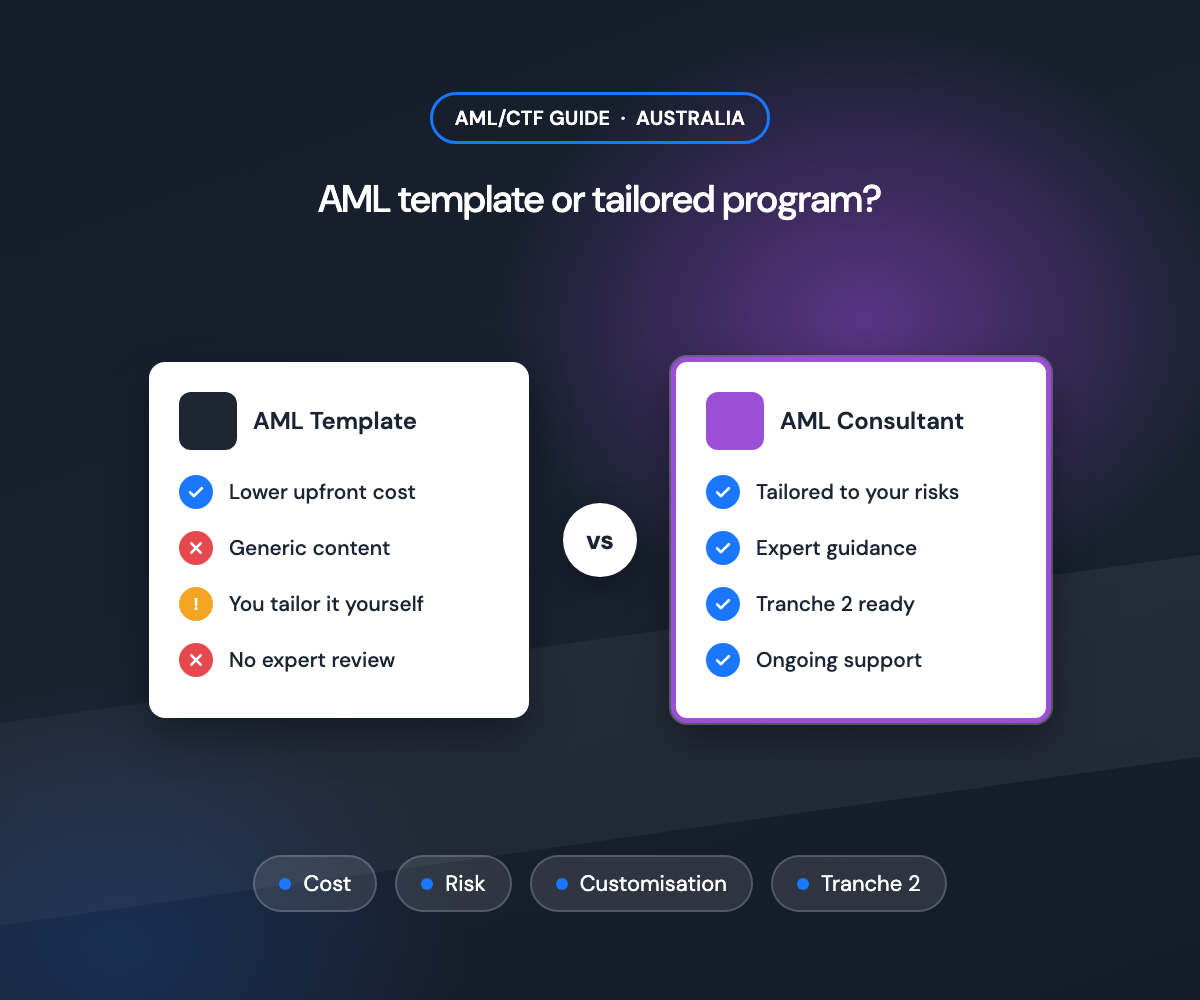
An AML template can look like the fastest way to get compliant. It is usually cheaper, easy to download and gives you something that looks like an AML/CTF program. For a busy business owner, that can feel like progress.
But AML/CTF compliance is not only about having a document. The real test is whether the program matches your business, your services, your customers, your risks and your day-to-day processes.
That is where the choice between an AML template and an AML consultant becomes important.
For Australian businesses subject to AML/CTF obligations, including those covered by the Tranche 2 reforms, which took effect on 1 July 2026, this decision can affect more than paperwork. It can shape how your team onboards clients, assesses risk, handles higher-risk matters, keeps records and responds when something unusual happens.
Importantly, an AML/CTF program must be in place before your business begins providing a designated service. Choosing the right approach is therefore an important part of preparing for and meeting your obligations.
AML Template vs Consultant: A Quick Overview
An AML template may be suitable if your business has straightforward operations and you have the knowledge to customise and implement it properly. An AML consultant may be a better option if you are unsure which obligations apply, have complex services or customer risks, or need support developing and implementing your AML/CTF program.
In some cases, a combination of both may work best. A template or starter kit provides a starting structure, while a consultant can help tailor it to your business's actual risks and operations.
A consultant is not a regulatory requirement. Your obligation is to develop, implement and maintain an appropriate AML/CTF program that meets the requirements applicable to your business.
What Is an AML Template?
An AML template is a pre-built document or set of documents designed to help a business create AML/CTF policies, procedures or program materials.
A template may include sections for:
- AML/CTF program overview
- Money laundering and terrorism financing (ML/TF) risk assessment
- Customer due diligence
- Customer risk ratings
- Enhanced customer due diligence
- Staff training
- Record keeping
- Reporting procedures
- AML/CTF compliance officer responsibilities
- Review and update processes
Templates can be helpful because they give businesses a starting point. They can reduce blank-page confusion and help structure the main areas that need to be considered.
However, a generic template is not automatically suitable for every business. It needs to be reviewed, edited and connected to how the business actually operates.
What Is an AUSTRAC Program Starter Kit?
AUSTRAC program starter kits are designed for newly regulated, small, low-complexity reporting entities in specified sectors that meet the relevant suitability criteria.
These kits provide sector-specific risk assessments, policies, procedures and supporting documents to help businesses develop their own AML/CTF programs.
However, the kits are not suitable for every business. Each has specific criteria that a business must assess against its own circumstances. Businesses that do not meet those criteria cannot automatically rely on the kit to satisfy AUSTRAC's expectations. They may need to adapt relevant materials or develop a more comprehensive program.
For example, AUSTRAC's starter kits for legal practices, accountants, real estate businesses and conveyancers each have sector-specific suitability requirements.
If you are considering a starter kit, check the relevant AUSTRAC program starter kits and assess whether the kit is appropriate for your business.
What Does an AML Consultant Do?
An AML consultant helps a business understand and apply its AML/CTF obligations in a practical way.
This may include support with:
- Confirming whether the business is captured
- Reviewing designated services
- AUSTRAC enrolment preparation
- AML/CTF program development
- ML/TF risk assessment
- AML/CTF compliance officer (AMLCO) support
- Customer due diligence procedures
- Customer risk rating frameworks
- Source of funds and source of wealth processes
- Staff training
- Starter kit customisation
- AML health checks
- Program reviews
- Remediation planning
A good consultant should not only explain what the law says. They should help translate AML/CTF obligations into steps your business can follow and maintain.
The scope of support will depend on the consultant and the engagement. Before proceeding, clarify which services are included and which responsibilities remain with your business.
AML Template vs Consultant: Main Differences
The choice between an AML template and a consultant usually comes down to complexity, internal capability and the level of support your business needs.
- Cost. AML Template or Starter Kit: Usually lower upfront. AML Consultant: Usually higher upfront.
- Customisation. AML Template or Starter Kit: Managed internally. AML Consultant: Can be supported by the consultant.
- Risk assessment. AML Template or Starter Kit: Requires internal knowledge and assessment. AML Consultant: Can include a tailored risk assessment.
- Implementation. AML Template or Starter Kit: Internal team applies the procedures. AML Consultant: Can include implementation guidance.
- Staff training. AML Template or Starter Kit: Arranged internally unless provided. AML Consultant: May be included in the engagement.
- Ongoing support. AML Template or Starter Kit: Depends on available resources. AML Consultant: May include reviews and ongoing advice.
- Best suited to. AML Template or Starter Kit: Businesses with the capability to customise and maintain their program. AML Consultant: Businesses needing specialist guidance or implementation support.
- Main consideration. AML Template or Starter Kit: The program must reflect actual business risks. AML Consultant: The scope and quality of the engagement matter.
A template is not necessarily the wrong choice, and a consultant is not automatically the better one. The important question is whether your chosen approach enables your business to develop, implement and maintain an appropriate AML/CTF program.
When to Use an AML Template or Hire a Consultant
An AML template or AUSTRAC starter kit may be a suitable starting point if your business meets the relevant suitability criteria and has the internal capability to customise and maintain its program.
This may apply if:
- Your services and customer types are relatively straightforward
- You understand your designated services and AML/CTF obligations
- You can complete a suitable ML/TF risk assessment
- You can customise the template or starter kit to reflect your business
- Your staff can follow the procedures, and your AML/CTF compliance officer can manage the program
An AML consultant may be more suitable if you need help understanding your obligations, assessing risks or implementing your program.
Consider external support if:
- You are unsure whether your business is captured or which designated services apply
- You need help with AUSTRAC enrolment
- Your business has multiple entities, trading names or complex customer structures
- Your work involves property transactions, client funds or customers with more complex risk profiles
- You need support with your ML/TF risk assessment, AMLCO responsibilities or staff training
- You need help customising an AUSTRAC starter kit or reviewing your existing program
For law firms, accountants, real estate agencies and conveyancers, client structures, property transactions, source of funds and multiple designated services may introduce additional compliance considerations.
Regardless of which option you choose, a template should not be copied and left unchanged. It needs to reflect your business model, designated services, customer risks and internal processes. If you use an AUSTRAC starter kit, check that your business meets the relevant suitability criteria and that the kit adequately addresses your risks.
A consultant can help address gaps and provide implementation guidance, but the scope of support will vary. Before engaging one, clarify what the service includes and which responsibilities your business will continue to manage internally.
Risks to Consider When Choosing an AML Template or Consultant
Both AML templates and consultant services have limitations. The key is to choose an approach that addresses your business's specific obligations, risks and operational needs.
Risks of Using an AML Template Without Customisation
The biggest risk with an AML template is assuming that completing the document means your business is ready to meet its obligations.
A business may fill in a few details without checking whether its procedures reflect its actual risks. Staff may then have policies to refer to but no clear guidance on how to handle real client matters.
Common issues include:
- Generic risk ratings that do not reflect the business
- No clear link between the risk assessment and designated services
- Incomplete customer due diligence procedures
- No practical escalation process
- Unclear triggers for enhanced customer due diligence
- Unclear AMLCO responsibilities
- No staff training plan
- Inadequate record-keeping procedures
- Policies that staff do not understand
- Controls that do not match daily operations
For example, a real estate agency may have a procedure for identifying customers but no clear process for assessing a transaction involving a complex ownership structure or an unexplained source of funds.
The issue is not necessarily the template itself. It is whether the business has identified its risks and put appropriate controls in place to address them.
Risks of Hiring the Wrong AML Consultant
Engaging a consultant does not automatically guarantee an appropriate AML/CTF program. The value of the engagement depends on the consultant's knowledge, approach and understanding of your business.
Be cautious if a consultant:
- Uses the same package for every business without assessing individual needs
- Does not ask about your designated services
- Cannot explain the risks relevant to your sector
- Focuses only on producing documents
- Does not clarify what implementation support is included
- Cannot explain how staff training will be handled
- Gives vague answers about your obligations
- Cannot explain how the risk assessment will be tailored
- Promises instant compliance
- Does not define the scope, deliverables and ongoing responsibilities clearly
A suitable AML consultant should explain the reasoning behind their recommendations, identify areas that need attention and provide guidance your team can apply.
Before engaging one, ask what the work will cover, how the program will be customised, what support is available after delivery and which responsibilities your team will continue to manage internally.
How to Decide Which Option Fits Your Business
Before choosing between an AML template and consultant support, consider three key factors.
1. Do You Understand Your Obligations?
Can you identify the designated services your business provides and determine which AML/CTF requirements apply? If you are uncertain about your regulatory position, seek appropriate guidance before selecting a template or starter kit.
2. Can Your Team Customise and Implement the Program?
Do you have someone who can complete the risk assessment, establish appropriate procedures, train staff and maintain the program? Having a document is only one part of the process.
3. How Complex Are Your Services and Risks?
Consider your customer types, ownership structures, transactions, service offerings and existing controls. If your business has several designated services or risks that are not adequately addressed by a standard starter kit, you may need additional controls or specialist advice.
If your business meets the relevant starter kit criteria and has the internal capability to customise and maintain its program, you may be able to manage the process without a consultant.
If several of these areas are unclear, external support may help you identify gaps, develop appropriate procedures and implement your program more effectively.
Can You Use an AML Template and a Consultant Together?
Using a template or starter kit alongside targeted consultant support can be a suitable approach for businesses that need guidance but want to manage costs.
Depending on your business's needs, this may involve:
- Starting with an appropriate template or AUSTRAC program starter kit
- Reviewing the program against your designated services and business risks
- Getting help to customise the ML/TF risk assessment and procedures
- Establishing clear processes for customer due diligence and escalation
- Training staff on their responsibilities
- Reviewing how the program works in practice
- Updating the program as your services, customers or risks change
This approach allows your business to use existing resources while obtaining specialist input where it is needed.
The aim is to develop an AML/CTF program that reflects your business's size, nature, complexity and risks, without adding unnecessary processes or leaving important gaps.
How One AML Can Help
One AML helps Australian businesses assess their AML/CTF requirements and develop programs that reflect their services, operations and risk profiles.
Support includes AML/CTF program development, ML/TF risk assessments, AUSTRAC enrolment preparation, AMLCO support, starter kit customisation, customer due diligence procedures, staff training and AML health checks.
For law firms, accountants, real estate businesses, conveyancers and other regulated businesses, One AML can help identify gaps in existing processes, customise program documents and establish procedures that staff can apply in day-to-day operations.
If you are unsure whether a template is suitable for your business or need help reviewing your existing AML/CTF arrangements, One AML can help you assess your options and determine what support may be appropriate.
Contact One AML to discuss your business's AML/CTF requirements.
FAQs
Is an AML template enough for compliance?
No. By itself, an AML template is not enough. It must be tailored to your designated services, customers, risks and operations, and supported by implementation, staff training, record-keeping and ongoing review. Your business must also have an appropriate AML/CTF program in place before providing a designated service.
What is better, an AML template or consultant?
It depends on your business. A template or AUSTRAC starter kit may suit a business that meets the relevant suitability criteria and has the internal knowledge and resources to customise and maintain its program. A consultant may be more suitable when you need help understanding your obligations, assessing risks or implementing procedures.
Can I use an AUSTRAC starter kit instead of a consultant?
Yes, if your business meets the suitability criteria for the relevant starter kit and can customise, implement and maintain the program appropriately. AUSTRAC starter kits are designed for newly regulated, small, low-complexity reporting entities in specified sectors. Businesses that do not meet the criteria may need to adapt relevant materials or develop a more comprehensive program.
Do I need an AML consultant to meet my obligations?
No. AUSTRAC does not require businesses to engage an AML consultant. Your business is responsible for having and maintaining an appropriate AML/CTF program that meets its obligations. A consultant can provide additional guidance and support if needed.
When should I hire an AML consultant?
Consider an AML consultant if you are unsure whether your business is captured, need help identifying designated services, have complex customers or transactions, or require support with your risk assessment, program development, implementation or staff training.
What can go wrong with an AML template?
A template may contain generic risk ratings, incomplete customer due diligence procedures, unclear escalation steps or policies that do not reflect how the business operates. These gaps can make it difficult for staff to apply the program consistently and manage identified risks.
Can One AML help customise an AML template?
One AML offers support with AML/CTF program development, starter kit customisation, risk assessments, customer due diligence procedures, AMLCO support and related compliance activities. The appropriate scope will depend on your business's needs.
Final Thoughts
Choosing between an AML template and a consultant comes down to your business's obligations, risks and ability to implement an appropriate program.
A template or AUSTRAC starter kit can provide a useful starting point, while consultant support can help address gaps, customise procedures and guide implementation.
Whichever approach you choose, your AML/CTF program must be in place before you begin providing a designated service and must continue to reflect your business's operations and risks as they change.
Ready to be free of your AML/CFT compliance stress?

