

AML Consultant vs AML Software: Which Do You Need?

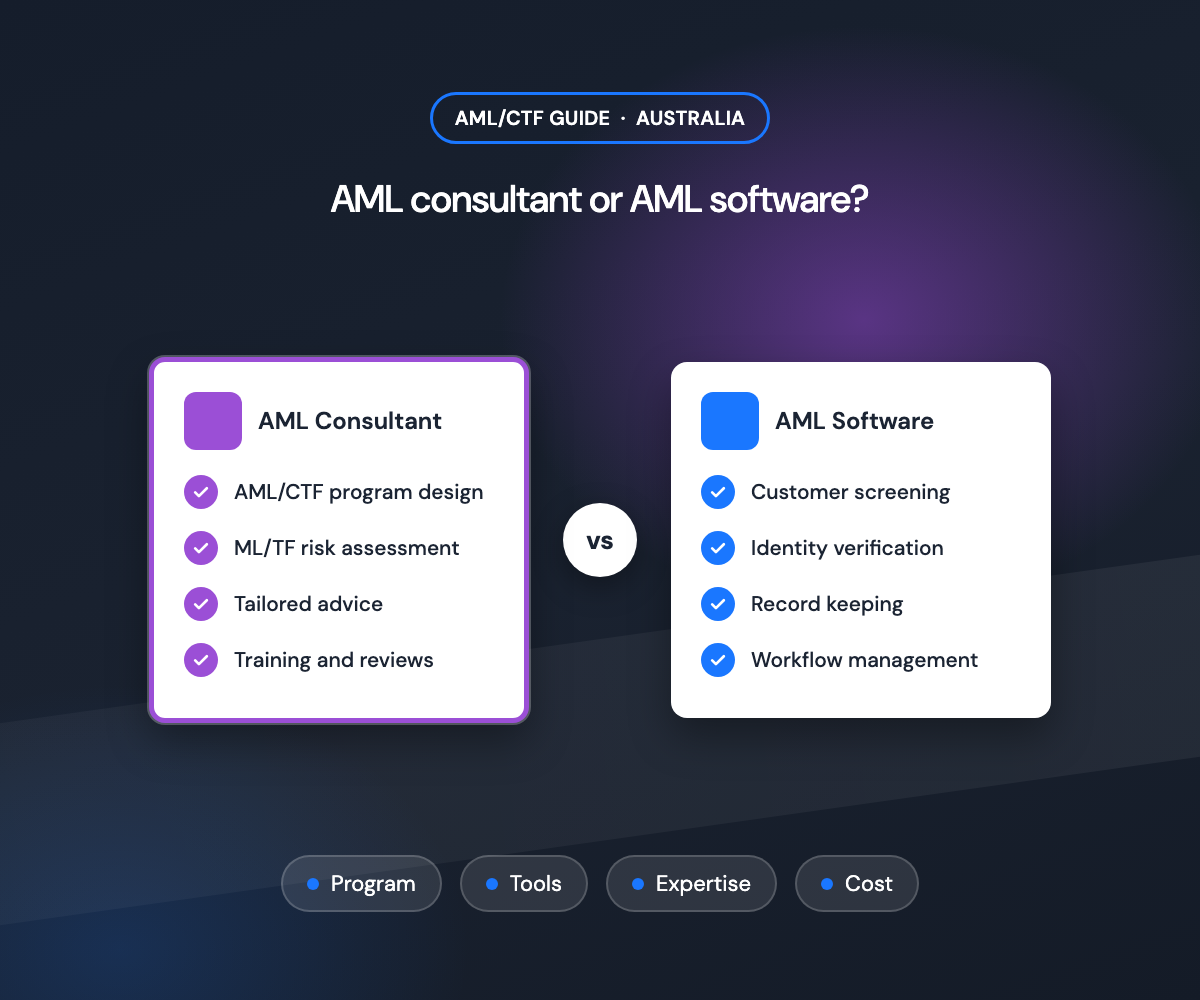
Australian businesses subject to anti-money laundering and counter-terrorism financing (AML/CTF) obligations may need to decide whether to engage a consultant, use AML software or combine both.
These options serve different purposes. AML software can support tasks such as customer screening, identity verification, record keeping and workflow management. An AML consultant can help your business understand its obligations, assess money laundering and terrorism financing (ML/TF) risks, and develop procedures suited to its operations.
For businesses affected by the Tranche 2 reforms, which commenced on 1 July 2026, the choice depends on your existing compliance arrangements and where you need support. If you already have a suitable AML/CTF program, software may help manage specific tasks. If you are still determining your obligations or developing your program, advisory support may be a more appropriate starting point.
This guide compares AML consultants and software, explains when each may be useful and outlines how to decide which option fits your business.
AML Consultant vs AML Software: What's the Difference?
Choosing between an AML consultant and AML software depends on your business's compliance needs, existing processes and available resources. While both can support your AML/CTF obligations, they serve different purposes and may be used separately or together. Understanding their roles can help you decide which option best suits your business.
- Understanding obligations. AML Consultant: Helps interpret requirements relevant to your business. AML Software: May provide guidance or features that support compliance workflows.
- Risk assessment. AML Consultant: Helps assess and document your ML/TF risks. AML Software: May support risk scoring based on configured rules and data.
- AML/CTF program. AML Consultant: Helps develop or customise policies and procedures. AML Software: May store and organise program documents.
- Customer due diligence. AML Consultant: Helps establish appropriate verification and escalation procedures. AML Software: May collect customer information and support identity checks.
- Screening and monitoring. AML Consultant: Helps determine appropriate controls and processes. AML Software: May automate screening, alerts and monitoring tasks.
- Implementation. AML Consultant: Can guide your team through applying procedures. AML Software: Can help operationalise configured workflows.
- Ongoing management. AML Consultant: May provide reviews, training and further advisory support. AML Software: May help maintain records, reminders and task histories.
The key distinction is that a consultant helps determine what your business needs to do, while software can help carry out and document parts of those processes. Your business remains responsible for meeting its AML/CTF obligations, including making required reporting decisions and submitting reports to AUSTRAC.
What Can AML Software Help With?
AML software can help businesses manage recurring compliance tasks through features such as:
- Customer onboarding and information collection
- Identity verification
- Sanctions, politically exposed person (PEP) and adverse media screening
- Customer risk scoring
- Workflow management and escalation alerts
- Document storage and record keeping
- Ongoing monitoring and audit trails
- Reporting dashboards
The available features depend on the platform and how it is configured. For example, a real estate agency may use software to collect customer details and support screening, while an accounting firm may use it to organise due diligence records and customer risk ratings.
Software may also flag potentially suspicious activity for further assessment. However, your business remains responsible for reviewing alerts, making reporting decisions and submitting required suspicious matter reports or threshold transaction reports to AUSTRAC.
Software is most useful when your business has established appropriate compliance procedures and needs tools to support them consistently.
What Can an AML Consultant Help With?
An AML consultant helps businesses understand their obligations and develop a compliance framework suited to their services, customers and risk profile.
Depending on the engagement, support may include:
- Reviewing whether your business provides designated services
- AUSTRAC enrolment and, where required, registration support
- AML/CTF program development and customisation
- ML/TF risk assessments
- AML/CTF compliance officer (AMLCO) guidance
- Customer due diligence and escalation procedures
- Staff training
- Program reviews and AML health checks
- Identifying compliance gaps and planning remediation
- Advising on where technology may support compliance processes
For example, a law firm may need to assess risks associated with property transactions, trusts, companies and client funds. An accounting practice may need to consider beneficial ownership and business structures, while a real estate agency may need procedures for customer verification and escalating higher-risk matters.
The scope of a consultant's service varies. Before engaging a provider, confirm the deliverables, implementation support and any ongoing assistance included.
When Should You Choose AML Software or a Consultant?
The right starting point depends on what your business has already established and where it needs assistance.
When AML Software May Be Suitable
Software may be suitable when your business already has a clear compliance framework and needs tools to manage particular tasks.
For example, you may benefit from software if:
- Your AML/CTF program and risk assessment are in place
- Customer due diligence procedures are defined
- Staff understand how to escalate concerns
- You need more organised screening or record keeping
- You want to manage onboarding and recurring tasks more consistently
- Your business has the internal expertise to configure and oversee the system
In these circumstances, software can support existing processes and help staff apply them consistently.
However, choosing a platform still requires care. Confirm that its features match your business's needs, that staff can use it appropriately and that its outputs can be reviewed by people with the necessary knowledge.
When an AML Consultant May Be More Appropriate
Advisory support may be a better starting point if your business is still working out what its obligations require or how to implement them.
Consider engaging a consultant if:
- You are unsure whether your services are designated services
- You need support with AUSTRAC enrolment or registration, where required
- You do not yet have an appropriate AML/CTF program
- Your risk assessment is missing, outdated or too generic
- You need to clarify the responsibilities of your AML/CTF compliance officer
- You are unsure what customer due diligence procedures to establish
- You are implementing or reviewing your Tranche 2 obligations
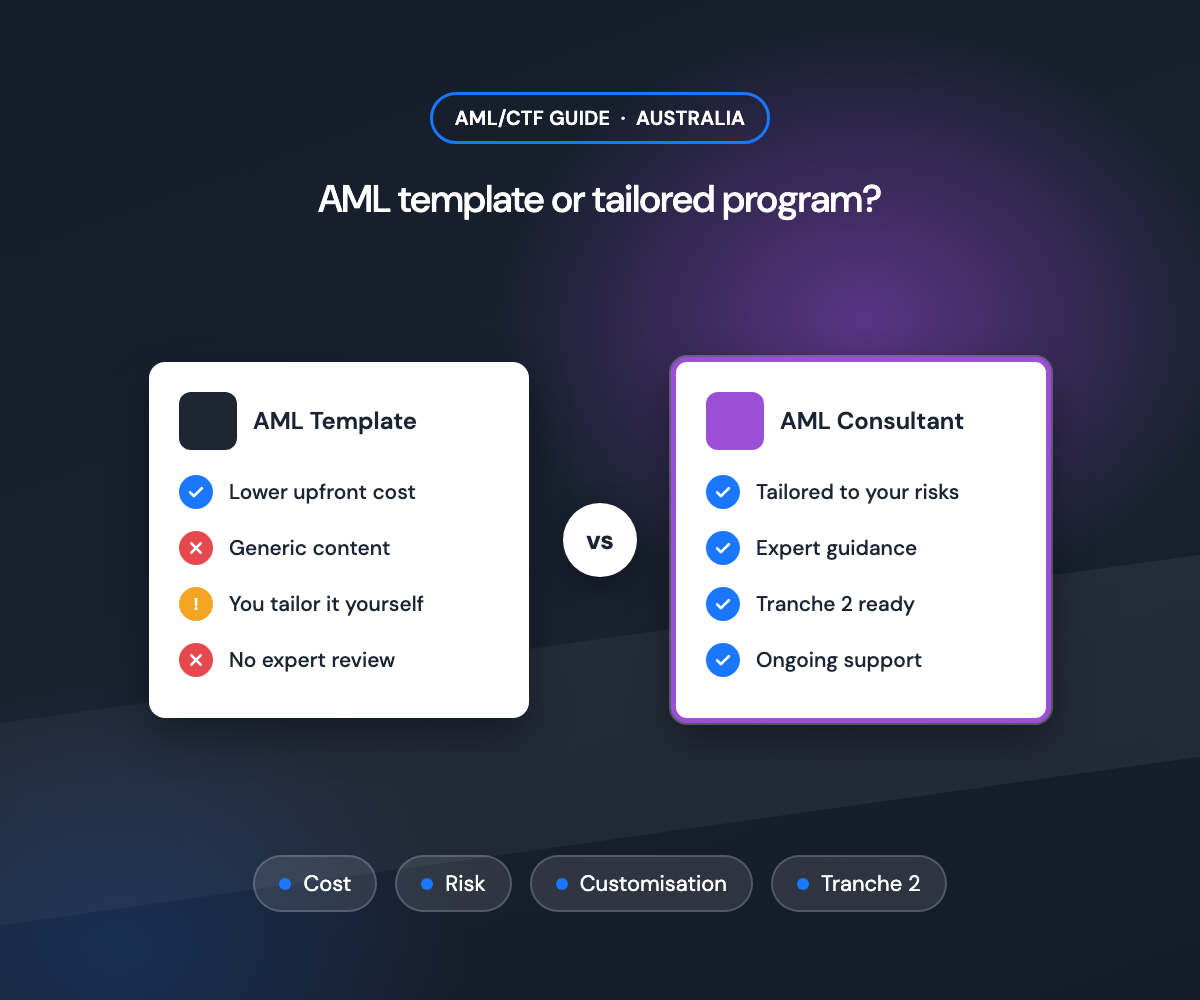
- You need to customise an AUSTRAC starter program
- Staff require training on their responsibilities
- You have identified gaps in your existing compliance arrangements
A consultant can help identify what needs to be addressed and determine which controls and processes are appropriate. Your business may then decide whether software would help manage those processes.
Neither option is automatically sufficient on its own. The decision should reflect your obligations, risk profile, internal capabilities and operational needs.
Can AML Consultants and Software Work Together?
Yes. In some businesses, combining advisory support with suitable technology can make compliance processes easier to manage.
A consultant may help establish the framework, while software supports selected tasks such as customer screening, document management and workflow tracking.
A possible sequence is:
- Determine whether your business provides designated services and identify the applicable obligations.
- Assess your ML/TF risks.
- Develop or customise your AML/CTF program.
- Establish customer due diligence, escalation and reporting procedures.
- Identify which tasks could benefit from software.
- Select and configure suitable tools.
- Train staff to follow the procedures and use the system.
- Review the arrangements and address gaps as your business or risks change.
The sequence may vary depending on your existing arrangements. A business with an established program may only need to improve a particular workflow, while another may need broader advisory support.
Technology should support your compliance framework rather than determine your entire approach by default. Your business also needs appropriate oversight to check that the system is working as intended and that required decisions and reports are handled correctly.
What Should You Consider When Comparing Costs?
The cost of AML software and consulting services depends on the scope of work, business requirements and level of support involved.
Software pricing may depend on factors such as user numbers, customer volumes, features and integrations. Consulting fees may depend on the complexity of your business, the work required to develop or review your program and whether implementation support or training is included.
Compare the overall value of each option rather than the initial price alone.
Consider the following questions:
- Scope: Does the service or platform cover the tasks you need?
- Implementation: What time and internal resources will setup require?
- Staff capability: Will your team need training or ongoing assistance?
- Additional costs: Are there fees for extra users, integrations, updates or further consulting?
- Ongoing management: What work will your business still need to perform?
- Suitability: Does the proposed solution reflect your operations and risk profile?
A lower upfront cost may not represent better value if the solution leaves important gaps or requires substantial additional work. Equally, a more comprehensive service may be unnecessary if your existing framework is suitable and you only need help with a specific task.
The aim is to choose support that addresses your actual needs without introducing unnecessary complexity.
How One AML Can Help
One AML supports Australian businesses with AML/CTF consulting and compliance services, including program development, ML/TF risk assessments, AUSTRAC enrolment support, AML/CTF compliance officer guidance, customer due diligence procedures, staff training, AUSTRAC starter program customisation, AML health checks and remediation.
For businesses comparing advisory support with software, understanding the applicable obligations and existing compliance gaps can help clarify which areas need attention before committing to additional systems.
One AML can discuss your business's requirements and the support that may be appropriate for developing or improving your AML/CTF framework.
Visit One AML or contact the team to discuss your compliance needs.
FAQs
Is AML software better than an AML consultant?
Neither is inherently better. Software supports tasks such as screening, record keeping and workflow management, while a consultant helps assess risks, develop procedures and interpret requirements relevant to your business. The appropriate option depends on your existing arrangements and what support you need.
Can AML software replace an AML consultant?
Software can automate and support selected compliance tasks, but it does not automatically determine whether your AML/CTF framework is appropriate. Businesses remain responsible for their obligations and may need internal expertise or external advice to establish and maintain suitable controls.
Do small businesses need AML software?
Not necessarily. Some small businesses may benefit from software for screening, onboarding or record keeping. Others may be able to manage their processes using suitable systems and procedures. The decision should reflect the business's obligations, risk profile, transaction volumes and internal capabilities.
When should I hire an AML consultant?
Consider consulting support if you are unsure which obligations apply, need help developing or reviewing your AML/CTF program, require a risk assessment or have identified gaps in your procedures. A consultant may also help clarify implementation requirements and staff responsibilities.
Can AML software help with customer due diligence?
Yes. Depending on the platform, software may support customer information collection, identity verification, screening, risk scoring and record keeping. Your business still needs appropriate procedures to determine which checks are required, how results are assessed and when concerns should be escalated.
What is an AUSTRAC starter program?
An AUSTRAC starter program is a program resource designed to help eligible businesses establish an AML/CTF program. Businesses should check the relevant suitability criteria and adapt the program to their circumstances where necessary. Using a starter program does not remove the business's responsibility to meet its applicable obligations.
Can One AML help with AML consulting?
One AML offers AML/CTF services including program development, risk assessments, AUSTRAC enrolment support, AML/CTF compliance officer guidance, staff training, starter program customisation, AML health checks and remediation. Contact the team to discuss which services may suit your business.
Final Thoughts
AML consultants and AML software serve different purposes. Consultants can help your business understand its obligations, assess risks and establish appropriate procedures. Software can support selected tasks and help staff manage those procedures consistently.
Start by assessing your existing AML/CTF arrangements and identifying where support is needed. You may need advisory services, technology or a combination of both.
Whatever you choose, your business remains responsible for maintaining appropriate controls, overseeing compliance activities and meeting its reporting and record-keeping obligations.
Ready to be free of your AML/CFT compliance stress?

