

How to Enrol With AUSTRAC: 2026 Business Guide

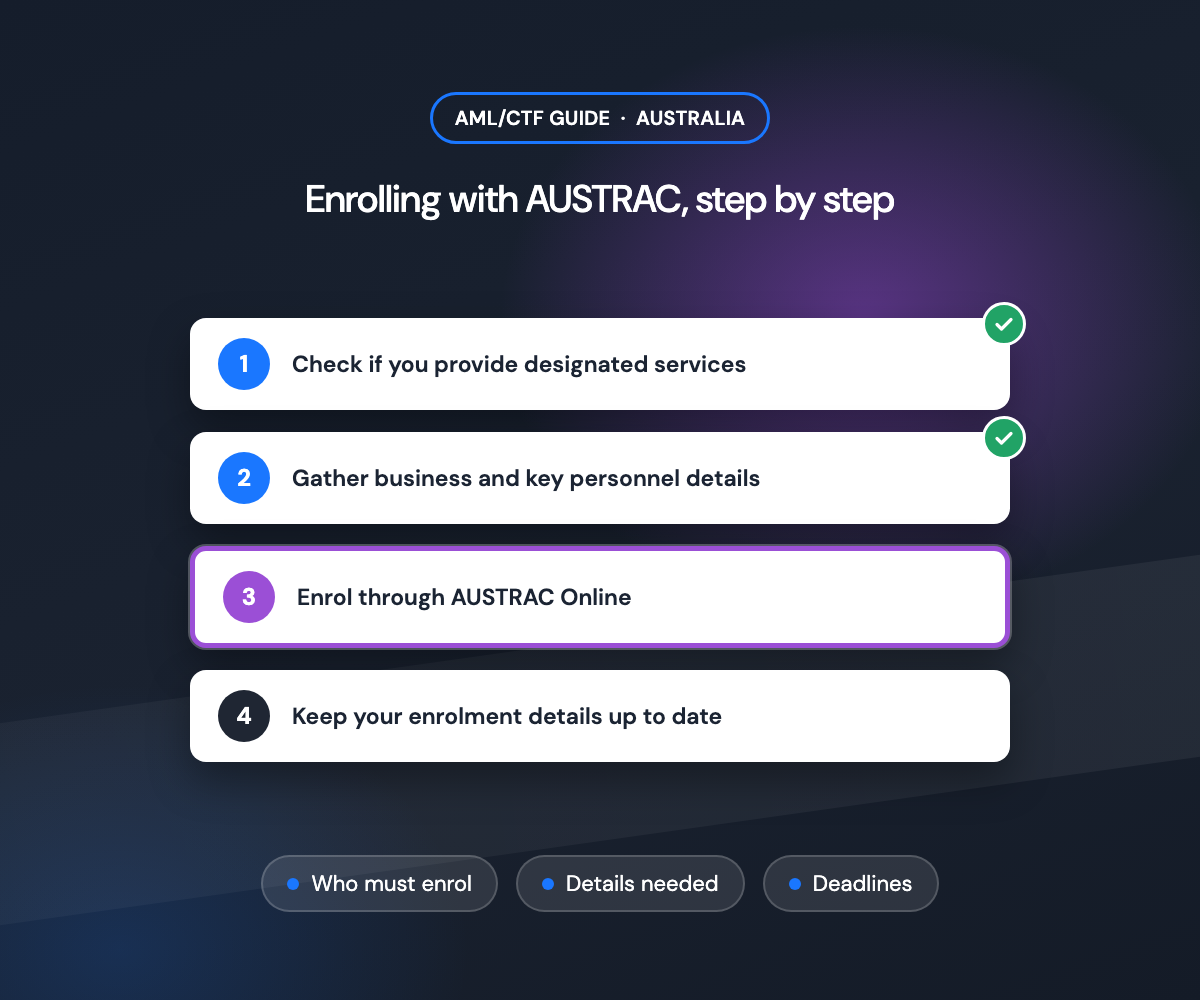
If your business provides designated services under Australia’s Anti-Money Laundering and Counter-Terrorism Financing (AML/CTF) regime, enrolment with the Australian Transaction Reports and Analysis Centre (AUSTRAC) is one of the first compliance obligations you may need to meet.
This has become particularly relevant following Australia's Tranche 2 AML/CTF reforms. From 1 July 2026, a broader range of businesses may be brought into the AML/CTF regime, including many law firms, conveyancers, accounting practices, real estate businesses, dealers in precious metals and stones, trust and company service providers, and some virtual asset service providers.
Understanding whether you need to enrol, when enrolment is required and what information you will need to provide is an important part of preparing for your AML/CTF obligations. This guide explains how AUSTRAC enrolment works, who needs to enrol and the key steps involved in the process.
Quick Answer: How Do You Enrol With AUSTRAC?
To enrol with AUSTRAC, you need to create an AUSTRAC Online user account, log in and complete the ‘Enrol New Business’ form. You will need to provide details about your business, business structure, designated services, identifiers, responsible people and other AML/CTF-related information.
In general, businesses must apply to enrol with AUSTRAC within 28 days of providing a designated service. For example, if your business begins providing a newly regulated designated service from 1 July 2026, you must apply to enrol by 29 July 2026.
For many Tranche 2 businesses, enrolment should not be handled in isolation. It should sit alongside your AML/CTF program, AML risk assessment, AML/CTF compliance officer appointment, staff training, customer due diligence processes and internal record keeping.
Who Needs to Enrol With AUSTRAC?
Your business generally needs to enrol with AUSTRAC if it provides a designated service with a geographical link to Australia.
You need to check:
- What services your business provides
- Whether those services are designated services under AML/CTF law
- Whether those services have a geographical link to Australia
- Whether your business is newly regulated under Tranche 2
- Whether you are already an existing reporting entity and need to update your details
For Tranche 2, this may affect businesses, such as:
- Law firms
- Conveyancers
- Accounting firms
- Bookkeepers, depending on services provided
- Real estate agents
- Buyers agents
- Property developers
- Dealers in precious metals, precious stones and related products
- Trust and company service providers
- Certain virtual asset service providers
Not every business in these industries will automatically have the same obligations. The key question is whether the business provides designated services.
Enrolment vs Registration: What Is the Difference?
Many businesses confuse enrolment and registration, but they are separate obligations under the AML/CTF regime.
Most newly regulated professional businesses, including lawyers, accountants, real estate agents, conveyancers and high-value dealers, will generally need to enrol with AUSTRAC if they provide designated services.
Registration is an additional requirement that applies to certain sectors, such as remittance service providers and some virtual asset service providers. The requirements that apply to your business will depend on the specific designated services you provide.
When Do You Need to Enrol With AUSTRAC?
Businesses must apply to enrol with AUSTRAC no later than 28 days after they begin providing a designated service.
For example, if your business begins providing a newly regulated designated service from 1 July 2026, you must apply to enrol by 29 July 2026.
Meeting the enrolment deadline is an important part of complying with your AML/CTF obligations and ensuring your business is properly recorded with AUSTRAC.
What Information Do You Need Before You Enrol?
Before starting the AUSTRAC enrolment form, gather your business information first. This will make the process easier and reduce the chance of errors.
You may need details, such as:
- Legal business name
- Registered business names or trading names
- Australian Business Number (ABN), if applicable
- Australian Company Number (ACN), Australian Registered Body Number (ARBN), Australian Registered Scheme Number (ARSN) or other Australian Securities and Investments Commission (ASIC) identifiers, if applicable
- Principal place of business
- Registered office address
- Business structure
- Designated services your business provides
- Industry or professional associations, if applicable
- Directors, partners, trustees or responsible people
- Governance and executive decision-makers
- Beneficial ownership details, where relevant
- Reporting group information, if relevant
- AML/CTF compliance officer details, where available
- Contact details for the business
The exact information required can depend on your structure. A company, partnership, sole trader, trust, association or reporting group may each need to provide different details.
Step-by-Step: How to Enrol With AUSTRAC
Step 1: Confirm Whether Your Business Needs to Enrol
Before you start the form, confirm whether your business provides designated services.
This is the step many businesses rush. For Tranche 2 businesses, the answer is not always based on industry name alone. A law firm, accounting practice or real estate business should review the actual services it provides.
For example, a law firm may need to consider whether it helps clients with captured property, company, trust or transaction-related services. A real estate business may need to consider the specific real estate services it provides. An accounting firm may need to review whether its work falls within professional designated services.
Step 2: Identify the Correct Business Entity
Make sure you enrol the correct legal entity.
This matters when a business has:
- Multiple related entities
- A trading name different from the legal name
- A trust structure
- A partnership structure
- A parent company and operating entity
- A reporting group structure
Enrolling the wrong entity can create confusion later when setting up your AML/CTF program, appointing your compliance officer, filing reports or updating business details.
Step 3: Create an AUSTRAC Online User Account
To enrol a business, you first need an AUSTRAC Online user account. This account allows you to access the online enrolment form and manage your business profile after enrolment.
The person creating the account should be someone who has authority to act for the business or has been properly authorised to manage the enrolment process.
Step 4: Log In and Select ‘Enrol New Business’
After your AUSTRAC Online user account is created, log in and go to the business section.
From there, select the option to enrol a new business. This opens the enrolment form. You can work through the form section by section and save your progress if you need to return later.
Step 5: Complete the Business Details
The form will ask for details about your business, including legal name, identifiers, structure, addresses and other profile information.
Accuracy matters here. Your enrolment details should match your business records, ASIC records, ABN details and internal compliance records where relevant.
Step 6: Select the Designated Services You Provide
This is one of the most important parts of the form.
You need to identify the designated services your business provides. These services determine why your business is captured under AML/CTF law and what obligations may apply.
Do not guess this section. If your business selects the wrong designated services, it may affect your compliance setup later.
Step 7: Add Responsible People and Governance Details
Depending on your business structure, you may need to provide information about directors, partners, trustees, officeholders, executives or other responsible individuals. For some businesses, this may include identifying people who make governance or executive decisions.
This section should be prepared carefully, especially for partnerships, trusts and businesses with layered ownership structures.
Step 8: Provide AML/CTF Compliance Officer Details
Your AML/CTF compliance officer is the person responsible for helping your business manage day-to-day AML/CTF compliance.
For newly regulated businesses, AUSTRAC transitional rules provide extra time to notify AUSTRAC of the AML/CTF compliance officer. However, from a practical perspective, businesses should identify this person early because the role connects directly with the AML/CTF program, risk assessment, staff training and internal compliance processes.
Step 9: Review the Form Before Submission
Before submitting, review every section carefully.
Check:
- Business name
- Business identifiers
- Business structure
- Designated services
- Contact details
- Responsible people
- AML/CTF compliance officer details
- Reporting group details, if relevant
Small errors can create unnecessary follow-up work later.
Step 10: Submit the Form and Save Your Confirmation
After submission, you should receive a confirmation message and email. This includes your receipt number and AUSTRAC Account Number, often called an AAN.
Keep this information safely. You may need it later for business profile updates, compliance reports, reporting group updates or future correspondence.
What Happens After You Enrol With AUSTRAC?
Enrolment is not the finish line. It is the start of your AML/CTF compliance journey.
After enrolment, your business should focus on practical implementation. This usually includes:
- Finalising your AML/CTF program
- Completing your ML/TF risk assessment
- Appointing or confirming your AML/CTF compliance officer
- Setting up customer due diligence procedures
- Training relevant staff
- Creating escalation procedures for suspicious matters
- Setting up record keeping processes
- Preparing internal governance and reporting processes
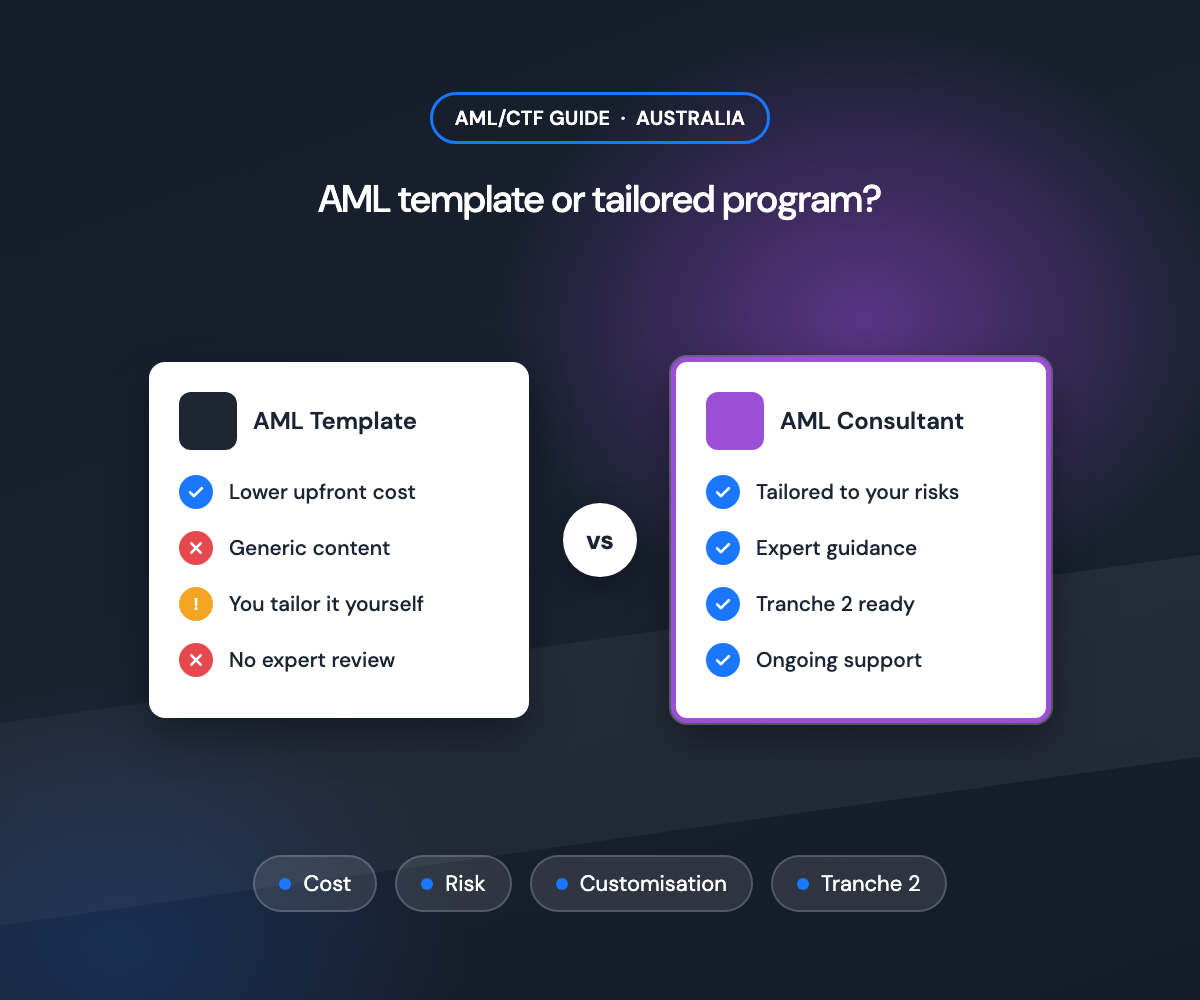
- Reviewing whether the AUSTRAC starter kit is enough or whether a tailored program is needed
For Tranche 2 businesses, these steps are especially important because compliance obligations begin from 1 July 2026.
Common Mistakes When Enrolling With AUSTRAC
Mistake 1: Waiting Until the Deadline
Enrolment may look like a form, but the preparation behind it takes time. Businesses need to understand their designated services, entity structure, responsible people and compliance setup.
Waiting until the last minute can create rushed decisions and avoidable errors.
Mistake 2: Confusing Enrolment With Full AML Compliance
Enrolling with AUSTRAC does not mean your business is fully AML/CTF compliant.
You still need the right AML/CTF program, risk assessment, compliance officer, training, policies, procedures, systems and controls.
Mistake 3: Selecting the Wrong Designated Services
This is one of the biggest risks. The designated services you select should reflect what your business actually provides.
Incorrect selections may create problems later when your business builds its AML/CTF program or responds to compliance questions.
Mistake 4: Using the Wrong Business Entity
Some businesses have multiple entities, trading names, partnerships or trust structures. Enrolling the wrong entity can create confusion and may require correction later.
Mistake 5: Not Preparing AML/CTF Compliance Officer Details
Even where extra time applies to notify AUSTRAC of your compliance officer, the business should still decide who will own AML/CTF compliance internally.
Without that person, the business may struggle to move from enrolment to actual implementation.
Mistake 6: Treating AUSTRAC Registration as the Same Thing
Most law firms, accountants, real estate businesses and conveyancers are looking at enrolment, not separate registration. Registration usually applies to remittance and certain virtual asset service providers.
Understanding this difference avoids unnecessary confusion.
Final Thoughts
AUSTRAC enrolment is one of the first practical steps for businesses captured by Australia’s AML/CTF regime. For newly regulated Tranche 2 businesses, it is also an important part of preparing for upcoming compliance obligations.
Businesses also need to understand their ML/TF risks, appoint the right AML/CTF compliance officer, develop an AML/CTF program, train relevant staff and establish customer due diligence and reporting processes.
If you are unsure whether your business needs to enrol or what your next steps should be, seeking professional guidance can help you prepare for your obligations with greater clarity.
Need Help Enrolling With AUSTRAC?
Completing the enrolment form is often the straightforward part. The bigger challenge is understanding whether your business is captured by the AML/CTF regime, identifying the designated services you provide and ensuring your enrolment aligns with your broader compliance obligations.
One AML helps Australian businesses navigate AUSTRAC enrolment and prepare for their AML/CTF responsibilities. This includes assessing ML/TF risk, developing AML/CTF programs, supporting AML/CTF compliance officers and establishing practical customer due diligence processes.
For law firms, accountants, real estate businesses, conveyancers and other newly regulated sectors, enrolment is only one step. Building a compliance framework that is practical, scalable and aligned with your obligations is just as important.
If you need help with AUSTRAC enrolment, speak with One AML about enrolment support, AML/CTF program development and Tranche 2 readiness to build a practical compliance framework for your business.
Ready to be free of your AML/CFT compliance stress?

