

What Is an AML Compliance Officer? Duties in Australia

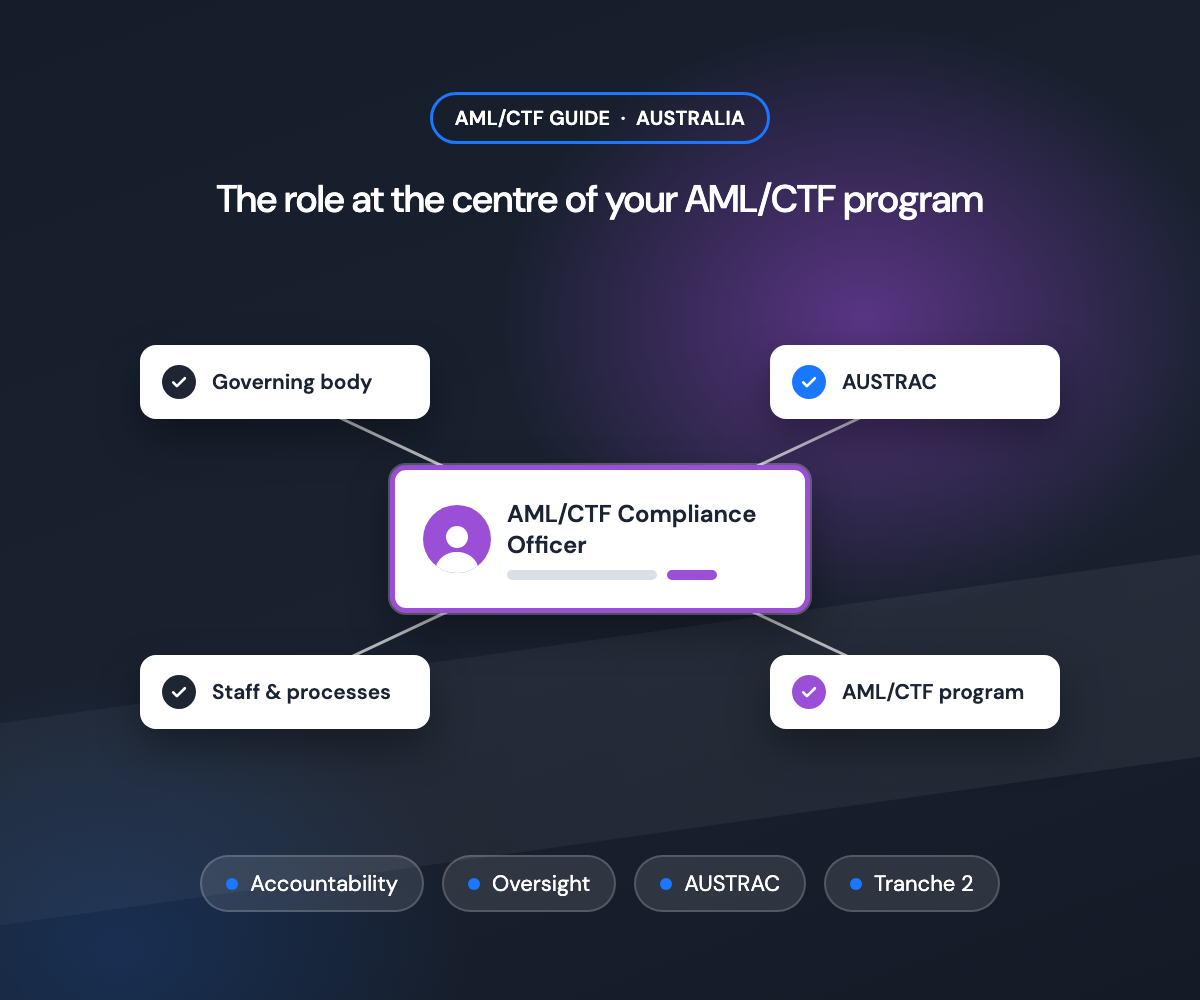
From 1 July 2026, thousands of Australian businesses will come under Australia’s Anti-Money Laundering and Counter-Terrorism Financing (AML/CTF) regulation for the first time under the Tranche 2 reforms. For many of these businesses, one of the first practical questions will be: who should be appointed as the AML/CTF compliance officer?
While appointing someone to the role is a requirement, choosing the right person involves more than simply assigning a title. The AML/CTF compliance officer plays an important role in helping a business manage its compliance obligations, oversee risk and support the implementation of its AML/CTF framework.
In this guide, we explain what an AML compliance officer is, who can fill the role, their key responsibilities and what Australian businesses should consider when preparing for AML/CTF compliance.
Quick Answer: What Does an AML Compliance Officer Do?
An AML compliance officer oversees and coordinates a business’s day-to-day compliance with AML/CTF laws, rules, regulations and internal policies. They help make sure the business follows its AML/CTF program, manages money laundering and terrorism financing risks, keeps senior management informed, and communicates with Australian Transaction Reports and Analysis Centre (AUSTRAC) when required.
In general, the AML compliance officer helps turn the AML/CTF program from a document into a working process inside the business.
That can include oversight of:
- AML/CTF policies and procedures
- Client onboarding processes
- Customer due diligence
- Staff training
- Risk assessment updates
- Suspicious matter reporting readiness
- Internal compliance issues
- Annual reporting to the governing body
- Ongoing improvements to the AML/CTF program
Why Is an AML Compliance Officer Important?
An AML/CTF program can look strong on paper but fail in practice if nobody owns the day-to-day process. That is where the AML compliance officer becomes important.
The role helps create accountability. It gives the business a clear person responsible for coordinating AML/CTF compliance, raising issues, escalating gaps and helping the governing body understand whether the business is meeting its obligations.
AUSTRAC expects newly regulated businesses to have an AML/CTF program, an AML/CTF compliance officer, trained staff and readiness to engage with clients and report suspicious matters by 1 July 2026.
For newly regulated firms, especially law firms, accounting practices, real estate agencies and conveyancers, this role should not be left until the last minute. The compliance officer needs time to understand the business’s ML/TF risks, internal processes, client types, services and reporting obligations.
AML Compliance Officer vs AMLCO: Are They the Same?
Yes. In practice, people often use AMLCO as a short form for AML compliance officer or AML/CTF compliance officer.
In Australia, the more accurate term is AML/CTF compliance officer because the laws cover both anti-money laundering and counter-terrorism financing obligations. Some businesses still use AMLCO because it is shorter and widely understood.
The title matters less than the function. The person must have enough authority, access, resources and practical understanding to perform the role properly.
Who Can Be an AML Compliance Officer?
An AML/CTF compliance officer must meet eligibility requirements. AUSTRAC guidance says the person must be employed or engaged by the business at management level, be a resident of Australia if the business provides designated services at or through a permanent establishment in Australia and be a fit and proper person.
In many smaller businesses, the AML/CTF compliance officer may be the owner, director, partner, principal or another person with sufficient authority over operations and risk. For larger businesses, the role may be filled by a risk manager, operations manager, general manager or compliance lead.
The person does not need to be a direct employee. An external AML/CTF compliance officer can be engaged, provided they have the authority, resources and expertise to perform the role effectively.
Regardless of who is appointed, the role should not be treated as a formality. The AML/CTF compliance officer needs enough authority, access and practical understanding to oversee compliance activities, coordinate the AML/CTF program and communicate with AUSTRAC when required. If the person lacks the time, knowledge or influence to perform these responsibilities, the business may struggle to meet its AML/CTF obligations properly.
What Are the Main Responsibilities of an AML Compliance Officer?
The AML compliance officer’s responsibilities can vary depending on the size, sector and risk profile of the business. However, the core role is to oversee and coordinate AML/CTF compliance.
1. Communicating with AUSTRAC
The AML/CTF compliance officer is responsible for communicating with AUSTRAC on the business’s behalf. This does not mean they handle every single operational task alone, but they need to be across the business’s obligations and compliance position.
2. Overseeing Day-to-Day AML/CTF Compliance
The compliance officer helps make sure the business follows its AML/CTF program in practice. This may include checking whether onboarding steps are followed, staff know what to do, customer risk ratings make sense and higher-risk matters are escalated properly.
3. Supporting the AML/CTF Program
AUSTRAC says an AML/CTF program must be tailored to the business and must include a money laundering and terrorism financing risk assessment and AML/CTF policies, procedures, systems and controls.
The compliance officer plays a central role in helping the business operate that program. They may not personally write every policy or perform every check, but they should understand how the program works and whether it is being followed.
4. Reporting to the Governing Body
AUSTRAC guidance says the AML/CTF compliance officer must report to the governing body at least once every 12 months. The report should cover the business’s compliance with AML/CTF policies, whether the policies manage and mitigate ML/TF risks and the business’s compliance with the Act, Rules and regulations.
This makes the role a governance function, not just an operational function.
5. Helping Identify Gaps and Remediation Needs
A good AML compliance officer should help the business identify problems early. That may include gaps in policies, weak staff training, inconsistent customer due diligence, unclear escalation processes, poor record keeping or risk assessment issues.
The goal is not to wait until something goes wrong. The goal is to keep the AML/CTF framework active, practical and aligned with the business’s actual risk.
Who Needs an AML Compliance Officer?
Businesses that provide designated services and fall under Australia’s AML/CTF regime need to appoint an AML/CTF compliance officer.
For newly regulated Tranche 2 businesses, AUSTRAC expects them to have an AML/CTF compliance officer by 1 July 2026 as part of their readiness steps.
This may include businesses, such as:
- Law firms
- Conveyancers
- Accounting firms
- Real estate agencies
- Buyers agents
- Property developers
- Trust and company service providers
- Dealers in precious metals, stones and products
- Certain virtual asset service providers
The exact requirement depends on whether the business provides designated services under the AML/CTF framework. A business should confirm whether its actual services are captured before assuming it is outside the rules.
What Skills Should an AML Compliance Officer Have?
An AML compliance officer does not need to know everything on day one, but they should have the right authority, judgement and willingness to understand the business’s risk.
Useful skills include:
- Understanding of AML/CTF obligations
- Strong knowledge of the business’s services and client base
- Ability to identify and escalate risk
- Practical judgement around customer due diligence
- Good record keeping and reporting discipline
- Ability to communicate with senior management
- Confidence to challenge weak processes
- Awareness of conflicts of interest
- Ability to coordinate training and internal follow-up
For Tranche 2 businesses, the compliance officer also needs to understand how AML/CTF obligations apply to the specific industry. A law firm will not have the same risk profile as a real estate agency, and an accounting firm will not have the same client onboarding process as a jeweller or property developer.
Can You Outsource the AML Compliance Officer Role?
A business may engage an external AML/CTF compliance officer, but the role still needs to function properly. The person must have enough authority, resources and expertise to perform the role.
For some businesses, external AMLCO support can be useful when internal staff do not have enough AML/CTF experience. It can also help when the appointed internal person needs guidance with complex client onboarding, risk assessment updates, customer due diligence questions or practical application of the AML/CTF program.
However, outsourcing does not remove the business’s responsibility. Senior management and the governing body still need to understand their AML/CTF obligations and take reasonable steps to oversee compliance.
What Should Businesses Have in Place Before Appointing an AML Compliance Officer?
Appointing the person is only one part of the process. The business also needs the right AML/CTF framework around them.
At a minimum, businesses should consider:
- Whether they are captured by AML/CTF obligations
- Whether they need to enrol with AUSTRAC
- Their ML/TF risk assessment
- Their AML/CTF program
- Customer due diligence procedures
- Staff AML/CTF training
- Escalation and suspicious matter reporting processes
- Record keeping procedures
- Internal reporting lines
- How the compliance officer will report to the governing body
Common Mistakes When Appointing an AML Compliance Officer
Choosing Someone Without Enough Authority
The compliance officer needs enough influence to coordinate AML/CTF processes. If they cannot access information, request changes, raise concerns or report issues, the role may not work properly.
Treating the Role as a Box-Ticking Exercise
The AML compliance officer is not just a name on a form. They need to help oversee the program in real business situations.
Not Giving the Officer Enough Training or Support
AML/CTF rules can be complex, especially for newly regulated industries. If the compliance officer has no training, no external support and no time allocated to the role, the business may create unnecessary compliance risk.
Ignoring Industry-Specific Risks
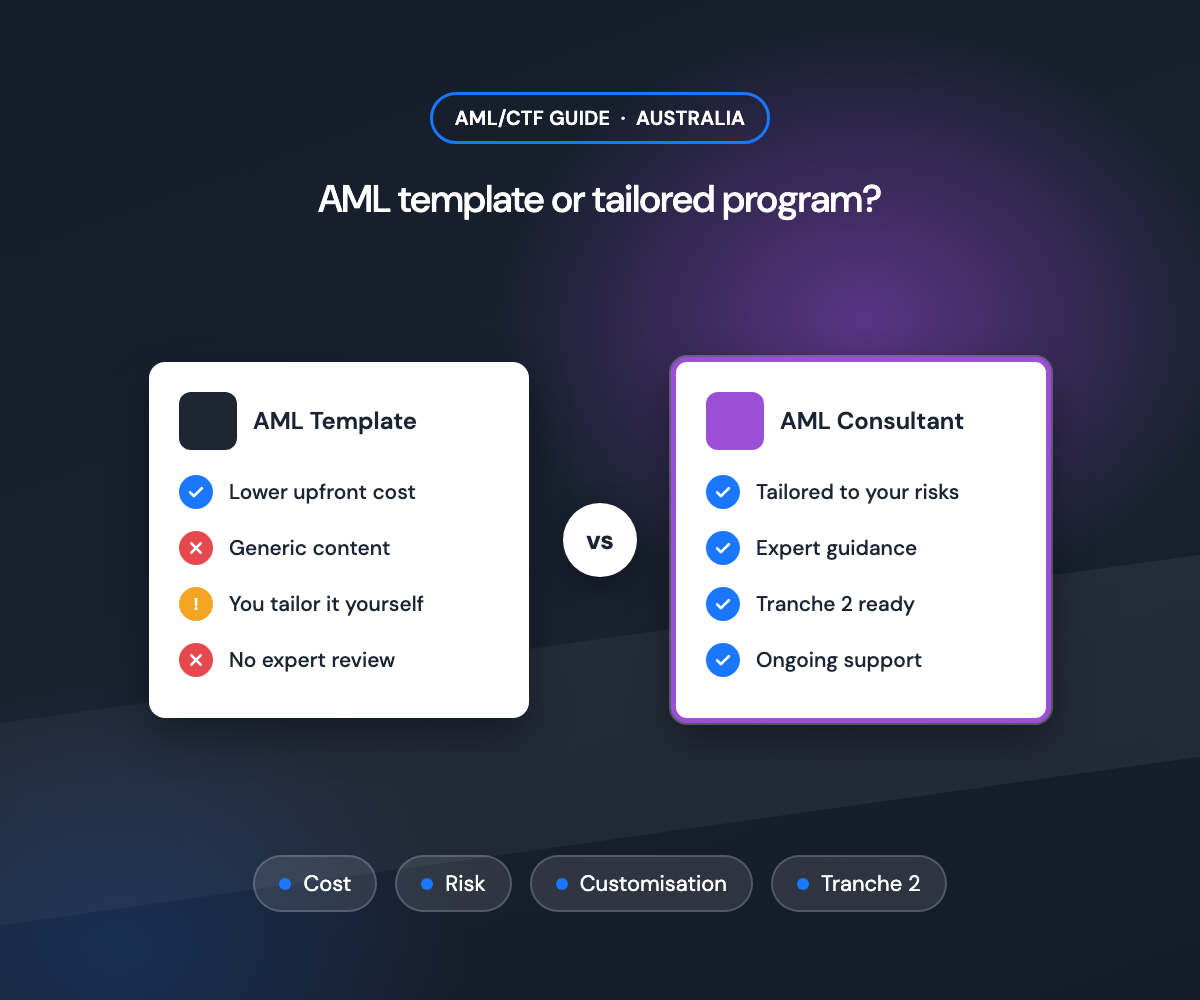
A generic AML process is rarely enough. A law firm handling client funds, a real estate agency handling property transactions and an accounting firm helping with company structures may all face different ML/TF risks.
Failing to Keep the Governing Body Informed
The AML compliance officer must report to the governing body at least annually. This helps senior leadership understand compliance gaps, risks and remediation steps.
Final Thoughts
An AML compliance officer plays a central role in helping a business meet its AML/CTF obligations. The role involves overseeing the AML/CTF program, supporting compliance activities, engaging with AUSTRAC where required and helping ensure the business maintains an effective compliance framework.
For businesses preparing for Tranche 2, appointing an AML compliance officer should not be treated as a last-minute formality. The role requires the right person, appropriate authority, ongoing training and a practical AML/CTF framework to support it.
Knowing the responsibilities of an AML compliance officer and how the role fits within your broader compliance framework can help your business prepare for its obligations and manage AML/CTF risk more effectively.
Need Help Supporting Your AML Compliance Officer?
AML/CTF compliance can involve complex regulatory requirements, evolving obligations and practical challenges that extend beyond day-to-day administration. Having the right support can help AML compliance officers carry out their responsibilities with greater confidence and clarity.
One AML works with Australian businesses to provide AMLCO support, AML/CTF program development, risk assessments, customer due diligence guidance, staff training, independent reviews and ongoing compliance advice. We can also assist with applying AML/CTF programs in practice, reviewing policies and controls, managing higher-risk matters and helping businesses meet their AML/CTF obligations.
If your business needs support with AMLCO responsibilities, AML/CTF program development or Tranche 2 readiness, speak with One AML about practical solutions tailored to your compliance obligations and level of risk.
Ready to be free of your AML/CFT compliance stress?

