

How to Choose an AML Consultant in Australia


Choosing an anti-money laundering and counter-terrorism financing (AML/CTF) consultant can be difficult when providers seem to offer similar services: compliance advice, risk assessments, programs, policies and reviews.
The difference is in how that support is delivered. A good consultant should help you understand which obligations apply to your business, identify your money laundering and terrorism financing (ML/TF) risks, build a workable AML/CTF program and help your team apply it in everyday situations.
This is particularly relevant for businesses affected by the Tranche 2 reforms, including law firms, accountants, real estate businesses, conveyancers, high-value dealers and other newly regulated sectors. AML/CTF compliance can affect client onboarding, customer due diligence, staff training, reporting, record keeping and ongoing governance.
So, how do you choose an AML consultant? This guide covers what to look for, the questions to ask before engaging a consultant and the red flags to watch for.
What Should an AML Consultant Help You With?
A good AML consultant should help your business understand its obligations and turn them into a framework your team can follow. Depending on your needs, this may include assessing your ML/TF risks, developing or customising your AML/CTF program, supporting customer due diligence, training staff and helping address compliance gaps.
The level of support will depend on your business, the services you provide and the resources you already have in place. The following steps can help you assess whether a consultant has the right experience and approach for your needs.
How to Choose an AML Consultant That Fits Your Business
The right fit will depend on your industry, regulatory obligations, ML/TF risks and the type of support your business needs. The following steps can help you assess potential consultants and find one that suits your business.
Choose a Consultant With Relevant Industry Experience
AML/CTF compliance is risk-based, so your program should reflect the services you provide and the ML/TF risks your business reasonably faces. AUSTRAC expects businesses to identify and assess their specific risks and develop policies that manage and mitigate those risks.
A consultant who understands financial services may not automatically understand the day-to-day risks of a small law firm, conveyancing practice, real estate agency or accounting firm. Each sector can have different customer types, transaction patterns, workflows and risk triggers.
For example:
- Law firms: Trusts, companies, property transactions, client funds and source of funds
- Accountants: Business structures, beneficial ownership, trusts, companies and advisory services
- Real estate businesses: Property transactions, buyers, sellers, developers and third-party payments
- Conveyancers: Settlement funds, customer identification, property transfers and unusual or urgent instructions
- High-value dealers: High-value goods, unusual payments, source of funds and customer identification
Before choosing a consultant, ask whether they have worked with businesses like yours. General AML/CTF knowledge is useful, but sector-specific understanding can make the advice much more relevant to your business.
Check Their Understanding of Tranche 2
For newly regulated businesses, the Tranche 2 reforms are a major reason to seek AML/CTF support. From 1 July 2026, AML/CTF obligations apply to newly regulated businesses providing relevant designated services.
Your consultant should be able to explain:
- Whether your business may be captured
- Which services may be designated services
- What enrolment requirements apply
- What your AML/CTF program needs to cover
- Who can act as your AML/CTF compliance officer
- How customer due diligence applies to your business
- What records you need to keep
- Whether AUSTRAC's program starter kit is suitable for your business and what needs to be customised
If a consultant gives vague answers or treats every Tranche 2 business the same way, be cautious. A small suburban law firm, an accounting practice and a real estate agency may all need AML/CTF support, but their risks and processes will not be identical.
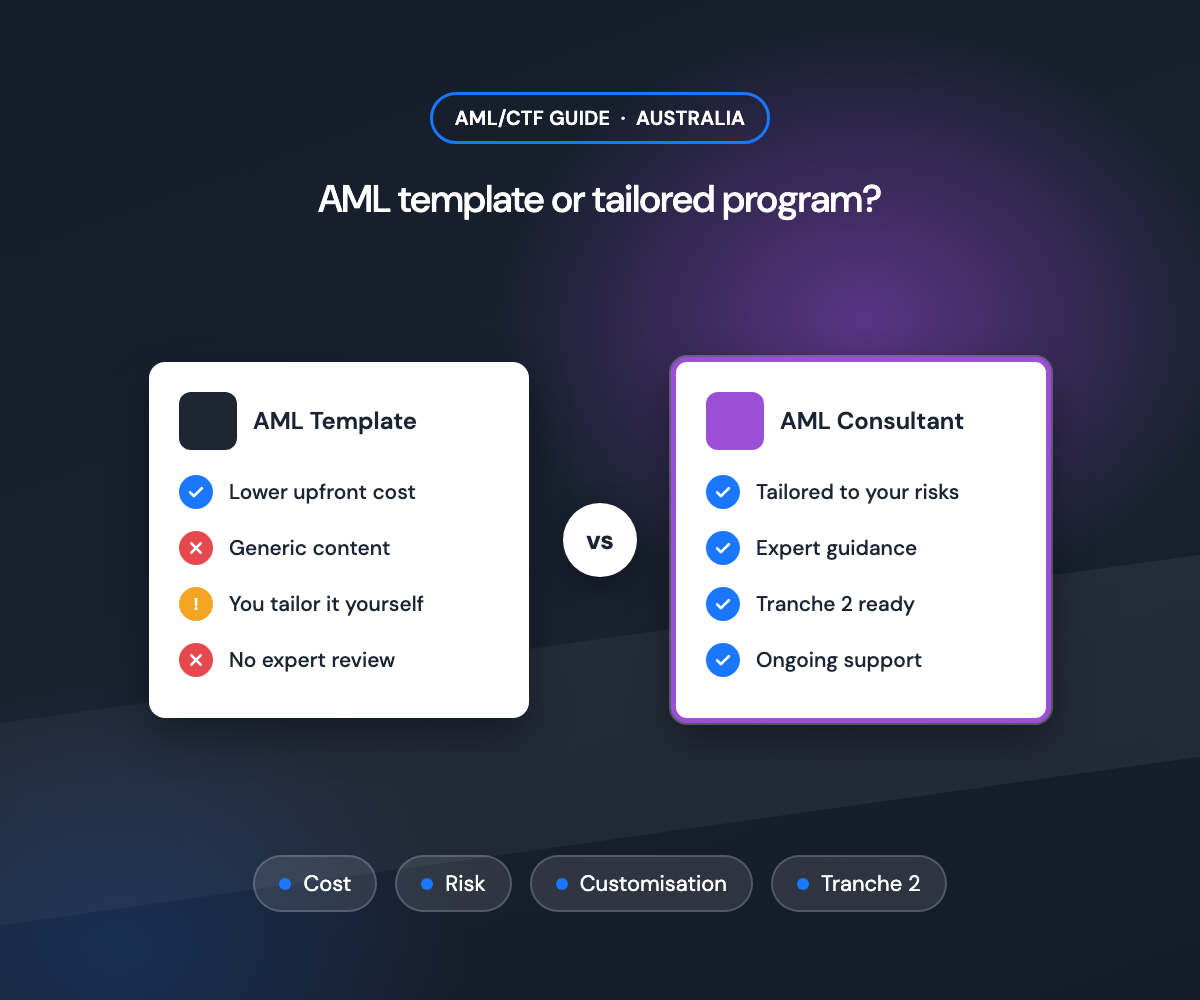
Look for Practical Program Development, Not Just Templates
Templates can be useful, particularly where they provide a starting point for developing an AML/CTF program. AUSTRAC also provides program starter kits for eligible businesses, but these are intended to help businesses build their own programs and may not apply to every situation.
A good consultant should help determine what needs to be customised based on your services, customers, delivery channels, jurisdictions, staff roles and ML/TF risks.
A weak approach looks like this:
‘We will give you an AML policy template.’
A stronger approach looks more like:
‘We will help identify your ML/TF risks, develop policies and procedures that match your services, establish customer due diligence processes, define escalation points, train staff and support implementation.’
The difference matters. Your AML/CTF program needs to be documented, approved, kept current and followed in practice.
Ask About Risk Assessment Capability
An ML/TF risk assessment is a core part of an AML/CTF program. AUSTRAC expects businesses to identify and assess the risks they reasonably face and use that assessment to shape their AML/CTF policies.
Your consultant should be able to help assess risks connected to:
- Customer types
- Services provided
- Transaction types
- Delivery channels
- Countries and jurisdictions
- Beneficial ownership
- Source of funds
- Source of wealth
- Politically exposed persons (PEPs) and sanctions
- Staff and process controls
The consultant should not simply label everything ‘medium risk’. They should be able to explain why particular risks are higher or lower and how your controls should respond.
A useful question to ask is:
‘How will you customise the risk assessment for our business?’
If the answer is unclear, the final work may be too generic to guide your day-to-day decisions.
Make Sure They Can Support Implementation
Some consultants are good at writing reports but less helpful when it comes to implementation.
For AML/CTF, implementation is where the framework needs to work in everyday business activity. Your staff need to know what information to collect, how to assess customer risk, when to escalate concerns, what records to keep and when enhanced customer due diligence may be required.
A practical AML consultant should be able to help with:
- Client onboarding workflows
- Customer due diligence procedures
- Higher-risk customer escalation
- AML/CTF compliance officer support
- Staff training
- Record keeping processes
- Internal review processes
- Ongoing compliance support
AUSTRAC requires reporting entities to conduct initial and ongoing customer due diligence, train relevant personnel and maintain records as part of their AML/CTF obligations.
This is especially important for smaller businesses that do not have in-house compliance teams. The consultant should make the process clearer, not more confusing.
Review Their Communication Style
AML/CTF compliance can become technical quickly. A good consultant should be able to explain complex obligations in a way your team can understand.
This matters because the final program will only work if people can understand and apply it.
Before engaging a consultant, notice whether they:
- Explain clearly
- Ask about your business before giving advice
- Avoid unnecessary jargon
- Give practical examples
- Understand your team's capacity
- Focus on what needs to happen next
- Can speak to both senior management and operational staff
If the consultant cannot explain the work clearly during the initial discussions, consider whether they will be able to communicate effectively during implementation.
Ask About Independent Evaluations
If you are choosing a consultant that also offers independent evaluations, ask how they manage independence.
Under the current AML/CTF framework, businesses must conduct independent evaluations of their AML/CTF programs. The frequency must be appropriate to the nature, size and complexity of the business, and an independent evaluation must occur at least every three years.
An evaluator should also be sufficiently independent from the work being evaluated. AUSTRAC expects the evaluator not to be responsible for implementing or maintaining the AML/CTF program, developing its systems and controls, or assessing its ML/TF risks.
This means you should ask:
- Who will conduct the evaluation?
- What relevant sector experience do they have?
- How do you ensure the evaluation is independent?
- What will be tested?
- Will you receive a written report?
- How will adverse findings be explained?
- Can you provide remediation support separately after the evaluation?
Be particularly careful if the same person is offering to develop your AML/CTF program and then independently evaluate that same work. The two functions need to remain appropriately separate.
How One AML Can Help
One AML supports Australian businesses with practical AML/CTF consulting, advisory and implementation support. This includes help with AML/CTF program development, ML/TF risk assessments, AUSTRAC enrolment preparation, AML/CTF compliance officer support, program starter kit customisation, customer due diligence, staff training, AML health checks, independent evaluations and remediation.
For law firms, accountants, real estate businesses, conveyancers and other newly regulated sectors, One AML can help translate AML/CTF obligations into practical steps that fit the way your business operates.
If you are unsure what type of AML/CTF supports your business needs, One AML can help you review your current position, identify gaps and determine the next steps.
FAQs
How do I choose an AML consultant?
Choose an AML consultant who understands your industry, can assess your ML/TF risks, supports practical implementation and can help with the AML/CTF requirements relevant to your business.
What should I ask an AML consultant?
Ask about their industry experience, understanding of Tranche 2, risk assessment process, AML/CTF program development, staff training, implementation support and what you will receive at the end of the engagement.
Do I need an AML consultant for Tranche 2?
Not necessarily. Businesses can develop their own AML/CTF programs and may be able to use an appropriate AUSTRAC program starter kit. However, professional support may be useful if you are unsure whether your business is captured, need help assessing your risks, require a tailored program or need support with implementation.
Is an AML consultant the same as an AML lawyer?
Not always. An AML consultant generally provides compliance, risk and implementation support, while an AML lawyer may provide legal advice. Some businesses may need one or both depending on the issue.
Should I choose a template provider or a consultant?
A template or program starter kit may help with structure, but it still needs to be appropriate for your business and circumstances. A consultant can help assess your risks, customise your program and support implementation where needed.
Can One AML help me choose the right AML/CTF approach?
Yes. One AML can help assess your AML/CTF obligations, develop or customise your program, complete risk assessments, support AUSTRAC enrolment and guide implementation.
Final Thoughts
Choosing an AML consultant is not only about finding someone who knows the rules. It is about finding someone who can help your business apply those rules in a practical way.
The right consultant should understand your sector, identify your real ML/TF risks, build a useful AML/CTF program, support your AML/CTF compliance officer and help your team follow the process. For newly regulated businesses, this choice can shape how smoothly AML/CTF implementation works. A good consultant should reduce confusion, not add to it.
If you need help understanding your AML/CTF obligations or putting a practical framework in place, contact One AML today to discuss your business's needs.
Ready to be free of your AML/CFT compliance stress?

