

What Does an AML Compliance Officer Do?

As Australia's Tranche 2 AML/CTF reforms expand the number of businesses captured by the AML/CTF regime, many organisations are preparing to appoint an AML/CTF compliance officer for the first time. While the role is a regulatory requirement for many reporting entities, it is much more than a title in an AML/CTF program.
An AML/CTF compliance officer helps oversee the business's AML/CTF framework, coordinates key compliance activities and supports the effective management of money laundering and terrorism financing (ML/TF) risks. The role provides oversight, guidance and accountability to help ensure the business's AML/CTF obligations are met in practice.
This guide explores the responsibilities of an AML compliance officer, how the role supports the AML/CTF framework and what businesses should expect from the person appointed.
The Responsibilities of an AML Compliance Office: A Quick Answer
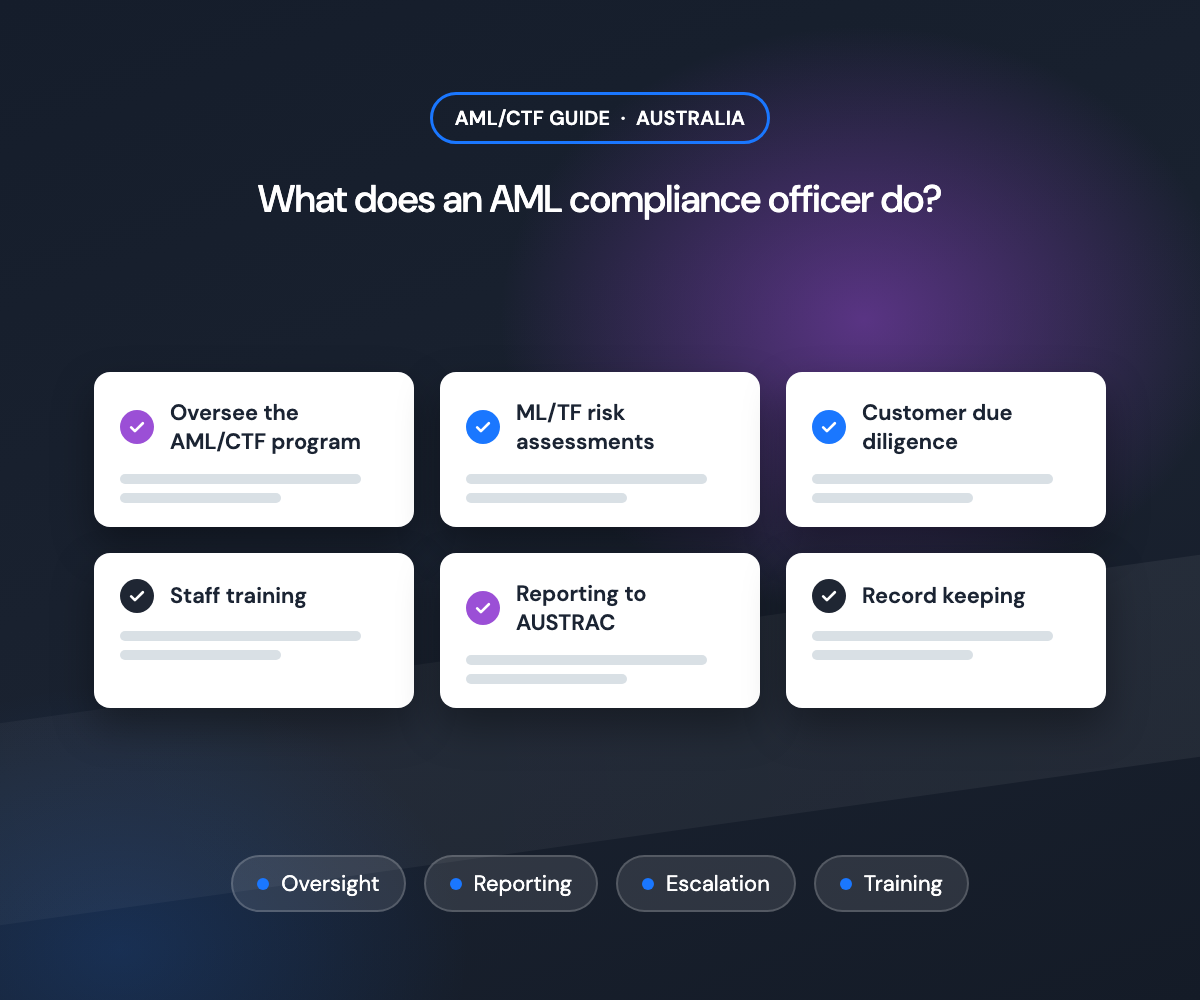
An AML compliance officer is responsible for overseeing key AML/CTF functions within the business and helping ensure regulatory obligations are met. Depending on the organisation, this may involve implementing the AML/CTF program, supporting ML/TF risk assessments, overseeing customer due diligence, coordinating staff training, supporting reporting processes and keeping senior management or the governing body informed.
While employees often carry out many of the operational compliance activities, the AML compliance officer provides direction, oversight and coordination to help ensure those activities are performed consistently and in line with the business's AML/CTF framework.
1. Overseeing the AML/CTF Framework
One of the AML compliance officer's primary responsibilities is overseeing the implementation of the business's AML/CTF framework and helping ensure compliance obligations are embedded into everyday operations. This may involve confirming that customer onboarding procedures are being followed, customer due diligence requirements are completed, risk ratings are applied consistently, higher-risk matters are escalated appropriately and required records are maintained.
For example, in a law firm, the AML compliance officer may oversee processes that ensure customer due diligence is completed before designated legal services are provided. In a real estate business, they may help verify that AML/CTF procedures are followed before captured property transactions proceed.
The role is not simply about developing procedures. It is about ensuring those procedures are practical, understood and consistently applied.
2. Implementing and Maintaining the AML/CTF Program
The AML/CTF program sets out how the business identifies, manages and mitigates ML/TF risk.
One of the AML compliance officer's key responsibilities is helping implement and maintain that program. This includes reviewing whether policies remain practical, ensuring controls reflect the business's actual risks and confirming staff understand how to apply AML/CTF procedures in their roles.
An effective AML/CTF program should support the way the business actually operates. If procedures require staff to verify the source of funds but employees are unsure when or how to do so, the AML compliance officer should help identify and address that gap.
3. Supporting the ML/TF Risk Assessment
ML/TF risk assessments are another important responsibility of the AML compliance officer. These assessments examine how the business could be exposed to money laundering or terrorism financing risks by considering factors such as customer types, designated services, delivery channels, jurisdictions, transaction patterns, technology and existing controls.
Depending on the business, the AML compliance officer may:
- Identify areas of higher ML/TF risk
- Review higher-risk services and customer types
- Assess customer and transaction risks
- Document risk ratings
- Link identified risks to appropriate controls
- Update the assessment as the business changes
A well-developed AML/CTF program should always reflect the risks the business actually faces.
4. Coordinating Customer Due Diligence
Customer due diligence (CDD) is one of the most important operational components of an AML/CTF framework.
The AML compliance officer may oversee or help develop processes for identifying customers, verifying identity, identifying beneficial owners, understanding the nature and purpose of the business relationship and assessing customer risk. They may also determine when enhanced customer due diligence is required.
For example, enhanced due diligence may be appropriate where a customer has complex ownership structures, links to higher-risk jurisdictions, politically exposed person (PEP) connections, an unclear source of funds or unusual transaction behaviour.
The AML compliance officer should also ensure staff understand what checks are required and when a matter should be escalated.
5. Escalating Higher-Risk Matters
Identifying and escalating higher-risk customers or activities is another important responsibility of the AML compliance officer.
Staff may identify warning signs during customer onboarding, document collection, transactions or ongoing business relationships. The AML compliance officer should oversee the process for reviewing these concerns and determining the appropriate next steps.
Examples of matters that may require escalation include:
- Unclear source of funds
- Unusual urgency
- Third-party payments
- Complex ownership structures
- Inconsistent customer information
- Sanctions or PEP concerns
- Transactions that do not match the customer's profile
- A customer refusing to provide required information
- Suspicious behaviour or unusual instructions
The role is not to assume wrongdoing, but to ensure potential risks are assessed appropriately and managed through the business's AML/CTF framework.
6. Managing Suspicious Matter Reporting Processes
Where a business forms a suspicion that a customer, transaction or activity may be linked to money laundering, terrorism financing or another relevant offence, suspicious matter reporting (SMR) obligations may apply.
The AML compliance officer should help establish a clear process for recognising, assessing and escalating suspicious matters. This may include determining what information should be collected, who should review the matter, when escalation is required and how reporting obligations will be managed.
Not every unusual activity results in a suspicious matter report. However, every reporting entity should have a documented process for identifying, assessing and managing potential suspicious matters.
For many businesses preparing for Tranche 2, this is one of the newest and least familiar aspects of AML/CTF compliance. The AML compliance officer plays an important role in helping staff recognise potential red flags and understand what action to take.
7. Coordinating AML/CTF Training
An effective AML/CTF framework depends on more than one person's knowledge. Staff who perform functions relevant to AML/CTF compliance need to understand their responsibilities and know how to apply the business's procedures.
The AML compliance officer may coordinate or support AML/CTF training for employees involved in customer onboarding, document collection, transaction processing, customer communications, compliance administration or management.
Training should generally cover:
- The business's AML/CTF obligations
- The business's ML/TF risks
- Customer due diligence procedures
- Customer risk ratings
- Red flags and escalation procedures
- Record-keeping requirements
- Suspicious matter reporting processes
- The responsibilities of the AML compliance officer
Training should be practical, role-specific and aligned with the way the business operates.
8. Maintaining AML/CTF Records
Maintaining accurate records is another important part of supporting an effective AML/CTF framework.
The AML compliance officer may oversee record-keeping processes to help ensure the business can demonstrate that AML/CTF obligations have been met. This includes documenting customer checks, compliance decisions, staff training and ongoing risk management activities.
Records may include:
- Customer identification and verification
- Beneficial ownership information
- Customer risk assessments
- Enhanced customer due diligence
- Source of funds or source of wealth checks
- Staff training records
- AML/CTF program updates
- ML/TF risk assessment reviews
- Internal compliance reports
- Escalation decisions
Well-maintained records help demonstrate that the AML/CTF framework is operating as intended and provide evidence of compliance if reviewed by AUSTRAC.
9. Overseeing Communications With AUSTRAC
Where required, the AML compliance officer may oversee or coordinate communications with AUSTRAC on behalf of the business. Depending on the business, this may include coordinating responses to information requests, updating business details, supporting enrolment requirements and overseeing other regulatory communications.
The AML compliance officer does not necessarily handle every interaction personally. However, they should have sufficient oversight of the AML/CTF framework to ensure regulatory communications are accurate, timely and appropriately managed.
10. Reporting to the Governing Body
Keeping senior management or the governing body informed is an important governance responsibility of the AML compliance officer. Regular reporting helps decision-makers understand how effectively the AML/CTF framework is operating, whether key risks are being managed and where improvements may be required.
Depending on the business, reports may include:
- Key ML/TF risks
- Progress in implementing the AML/CTF program
- Staff training completion
- Customer due diligence issues
- Higher-risk customers or matters
- Record-keeping gaps
- Audit or independent review findings
- Remediation activities
- Recommended improvements
Regular reporting also supports informed decision-making and helps ensure the governing body remains aware of the business's AML/CTF compliance obligations.
What an AML Compliance Officer Should Not Be
An AML compliance officer should be more than a name listed in an AML/CTF program. To perform the role effectively, they need appropriate authority, access to information and support from the business.
The role may not be suitable for someone who:
- Has insufficient time to perform the role
- Has limited access to customer or transaction information
- Cannot influence internal procedures
- Cannot escalate compliance concerns
- Does not understand the business's ML/TF risks
- Does not have support from senior management
- Is expected to manage AML/CTF compliance without appropriate resources
While the AML compliance officer provides oversight and coordination, responsibility for meeting AML/CTF obligations ultimately rests with the business and its governing body.
How One AML Can Help
Appointing an AML compliance officer is only one part of building an effective AML/CTF framework. Businesses also need practical policies, documented procedures and ongoing support to meet their obligations.
One AML helps Australian businesses establish and maintain practical AML/CTF compliance frameworks through AML/CTF program development, ML/TF risk assessments, customer due diligence procedures, AML/CTF training, AUSTRAC enrolment support and ongoing AML compliance advice. Whether you're preparing for Tranche 2 or strengthening an existing AML/CTF framework, our team can help you implement practical compliance processes that align with your business and regulatory obligations.
FAQs
What does an AML compliance officer do?
An AML compliance officer oversees a business's AML/CTF framework and helps coordinate the processes that support compliance. Responsibilities typically include supporting the AML/CTF program, coordinating ML/TF risk assessments, overseeing customer due diligence, supporting suspicious matter reporting, coordinating staff training, maintaining records and reporting to senior management or the governing body.
Is an AML compliance officer responsible for the AML/CTF program?
The AML compliance officer helps implement, oversee and maintain the AML/CTF program. However, responsibility for meeting AML/CTF obligations remains with the business and its governing body.
Does the AML compliance officer need to be at management level?
Yes. The AML compliance officer should be at management level and have the authority, access to information and resources needed to perform the role effectively.
Can the AML compliance officer be external?
Depending on the business's circumstances, external AML compliance support may be appropriate. However, the business remains responsible for meeting its AML/CTF obligations.
Does the AML compliance officer train staff?
The AML compliance officer may coordinate or support AML/CTF training to help ensure relevant employees understand the business's obligations, procedures and escalation processes.
Can One AML support an AML compliance officer?
Yes. One AML provides practical support with AML/CTF program development, ML/TF risk assessments, customer due diligence, AML/CTF training, independent reviews and ongoing compliance guidance.
Final Thoughts
An AML compliance officer plays an important role in helping a business implement and maintain an effective AML/CTF framework. By providing oversight, coordinating key compliance activities and supporting staff across the business, they help turn AML/CTF policies into practical processes.
As businesses prepare for Tranche 2 and ongoing regulatory change, appointing the right AML compliance officer can make compliance more effective and easier to manage. To perform the role successfully, the AML compliance officer needs the authority, knowledge, resources and organisational support to oversee the business's AML/CTF framework effectively.
Need help appointing or supporting an AML compliance officer? Speak with One AML about AMLCO support, AML/CTF program development, ML/TF risk assessments, staff training and Tranche 2 readiness.
Ready to be free of your AML/CFT compliance stress?

