

Do I Need an AML Consultant for My Business?

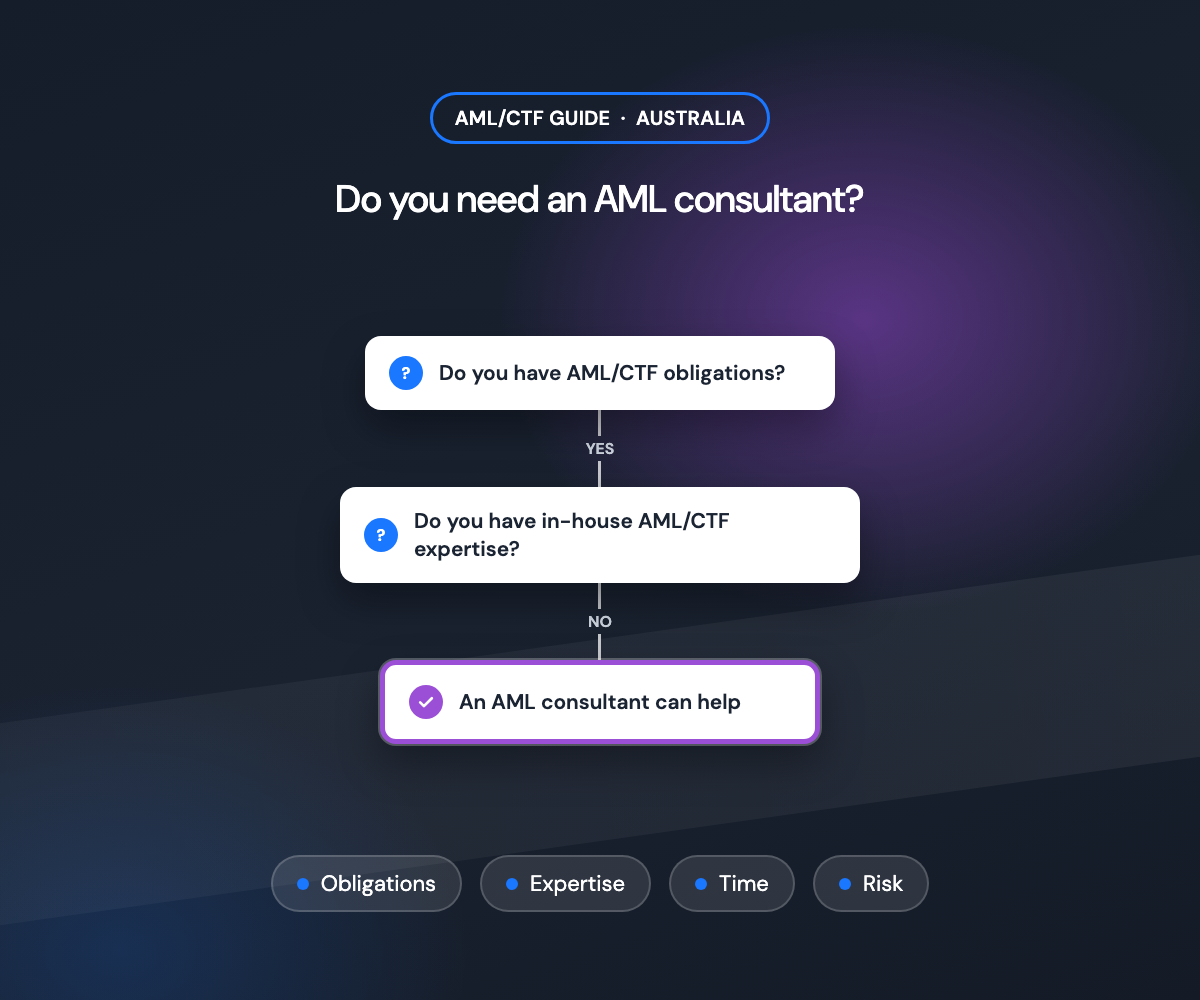
If your business is subject to Australia's anti-money laundering and counter-terrorism financing (AML/CTF) laws, you may be wondering whether you need an AML consultant or can manage compliance internally.
The answer depends on your business, the designated services you provide, your risk profile and the knowledge and resources available to your team. You may need to identify which obligations apply, complete a money laundering and terrorism financing (ML/TF) risk assessment, develop an AML/CTF program and establish procedures for customer due diligence, staff training and record-keeping.
An AML consultant can help with these tasks, but engaging one is not a regulatory requirement. Your business is responsible for having an appropriate AML/CTF program in place before providing a designated service and maintaining it as your circumstances change.
When Should You Consider an AML Consultant?
An AML consultant may be useful if your business needs help understanding its obligations, developing its AML/CTF program or putting compliance procedures into practice.
Consider external support if:
- You are unsure whether your services are designated services under AML/CTF laws.
- You need help preparing for or completing AUSTRAC enrolment.
- You do not have an AML/CTF program or your existing program needs updating.
- You need help completing an ML/TF risk assessment.
- Your team is unsure how to apply customer due diligence requirements.
- Your AML/CTF compliance officer (AMLCO) needs additional guidance.
- You need to establish customer risk ratings and escalation procedures.
- You have identified gaps in your existing compliance arrangements.
- You need support training staff or implementing new procedures.
- You want an external review of your current AML/CTF framework.
These considerations are particularly relevant to businesses in newly regulated sectors, including legal services, accounting, conveyancing, real estate and certain high-value dealing activities.
The obligations that commenced for newly regulated businesses on 1 July 2026 require affected businesses to have appropriate arrangements in place. If your business has not yet addressed its applicable obligations, assess the gaps and take steps to address them promptly.
You can check your obligations and access official guidance through AUSTRAC.
What Does an AML Consultant Do?
An AML consultant helps businesses understand their obligations and establish processes to identify, assess and manage ML/TF risks.
Depending on the engagement, support may include:
- Obligation and service reviews: Identifying designated services and assessing which AML/CTF requirements apply.
- AUSTRAC enrolment preparation: Helping organise the information required for enrolment.
- AML/CTF program development: Developing or customising policies and procedures to reflect the business.
- ML/TF risk assessments: Identifying relevant risks associated with services, customers, transactions and business operations.
- Customer due diligence: Establishing procedures for identifying and verifying customers and assessing their risk.
- AMLCO support: Helping clarify responsibilities and establish processes for overseeing compliance.
- Staff training: Explaining procedures and responsibilities so employees can apply them consistently.
- Implementation support: Helping translate written policies into day-to-day processes.
- Program reviews and AML health checks: Identifying gaps and recommending improvements to existing arrangements.
- Remediation planning: Prioritising issues and developing steps to address identified weaknesses.
The scope will depend on the provider and the services agreed upon. Before engaging a consultant, clarify what will be delivered, whether implementation support is included and which responsibilities remain with your business.
The goal is to establish an AML/CTF program that works in practice, rather than simply producing a set of documents.
Signs Your Business May Need AML Support
Some gaps indicate that your business may benefit from specialist guidance.
Your Obligations Are Unclear
If you cannot confidently identify your designated services or explain which requirements apply, you may need help assessing your regulatory position before developing your program.
Your Risk Assessment Is Too Generic
An ML/TF risk assessment should reflect your business's actual services, customers, delivery methods and other relevant risk factors. Generic wording may leave important risks unaddressed.
Staff Do Not Know How to Apply the Procedures
Collecting identification documents is only one part of customer due diligence. Staff also need to understand how to assess relevant risks, recognise when additional checks are needed and escalate concerns.
Responsibilities Are Not Clearly Defined
Your business needs appropriate arrangements for overseeing AML/CTF compliance. If the AMLCO role, escalation process or approval responsibilities are unclear, these areas may need attention.
Your Program Has Not Been Customised or Reviewed
A template or AUSTRAC program starter kit can provide a useful starting point, but it must be appropriate for your business and customised where necessary. Your program must also be reviewed and updated as your circumstances and risks change.
Your Business Has More Complex Risks
Multiple designated services, complex ownership structures, cross-border relationships and high-value transactions may require more detailed risk assessment and controls. These factors do not automatically mean you need a consultant, but they may increase the value of specialist support.
Addressing these issues can help your team establish clearer procedures and identify gaps before they lead to compliance problems.
When You May Not Need Full Consulting Support
Not every business needs a large AML consulting engagement.
You may be able to manage your program internally if your business has:
- A clear understanding of its designated services and obligations
- The knowledge and capacity to assess and manage its ML/TF risks
- An appropriately customised AML/CTF program
- Clear customer due diligence and escalation procedures
- Staff who understand their responsibilities
- Appropriate arrangements for record-keeping, training and ongoing review
Eligible small businesses may also be able to use an AUSTRAC program starter kit. These kits are designed for newly regulated, small, low-complexity reporting entities in specified sectors that meet the relevant suitability criteria. They are not automatically suitable for every business.
If your team can manage the program effectively but needs help with a specific issue, targeted support may be sufficient. This could include an AML health check, a review of the risk assessment, staff training or a session to clarify AMLCO responsibilities.
The important consideration is whether your business can meet its obligations effectively, not whether you have engaged an external provider.
Comparing AML Consultants, Templates and Lawyers
Choosing the right type of AML support depends on what your business needs. A template can provide a starting point for your AML/CTF program, a consultant can help with compliance processes and implementation, and a lawyer can provide legal advice on complex regulatory matters. Understanding these differences can help you decide which option is appropriate for your business.
AML Consultant vs Template Provider
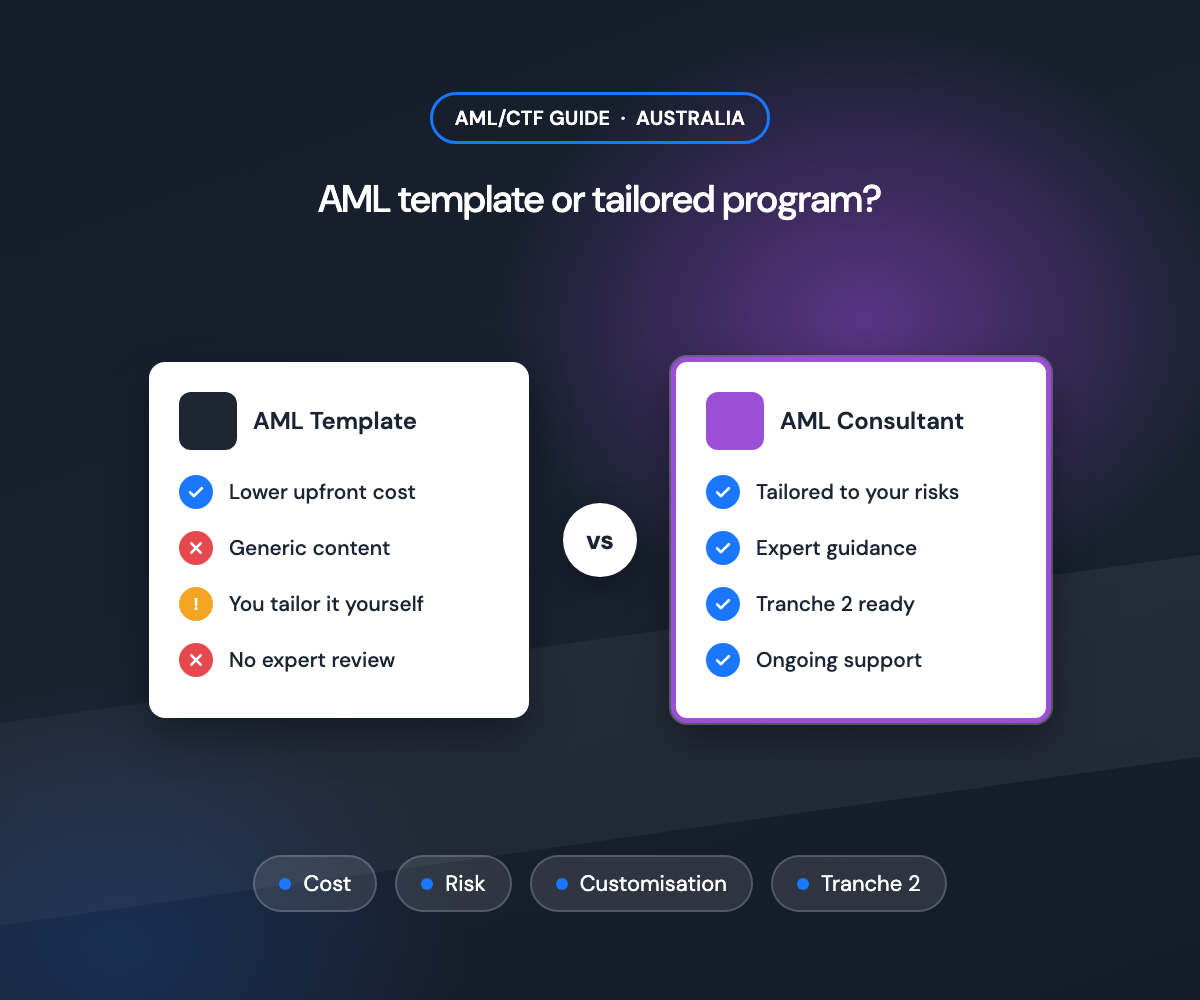
An AML template provides a structure for your AML/CTF documents, while a consultant can help determine how that structure should apply to your business.
For example, a template may include a customer due diligence policy, but your business still needs to determine:
- What information to collect for its designated services
- How to identify and assess customer risks
- When enhanced customer due diligence is required
- How staff should escalate concerns
- Who is responsible for relevant decisions
- How records will be maintained
A suitable template or AUSTRAC starter kit may be enough as a starting point if your business meets the relevant criteria and has the knowledge and resources to customise and implement it. However, a generic template should not be adopted without checking that it reflects your actual obligations and risks. Consultant support may help address gaps where additional guidance is needed.
AML Consultant vs AML Lawyer
An AML consultant and an AML lawyer provide different types of support, although their services may overlap.
An AML consultant typically focuses on compliance processes, risk assessments, AML/CTF program development, implementation and staff training. An AML lawyer may provide legal advice on statutory interpretation, complex regulatory questions, enforcement matters, disputes and other legal issues.
Your business may need one or both, depending on its circumstances. For example, a consultant may help develop customer due diligence procedures, while a lawyer may be appropriate when you need advice on how a particular legal requirement applies to a complex situation.
Before engaging either provider, clarify the scope of their services and whether you need compliance implementation support, legal advice or both.
How One AML Can Help
One AML supports Australian businesses with AML/CTF compliance, including program development, ML/TF risk assessments, AUSTRAC enrolment preparation, AMLCO support, customer due diligence procedures, staff training, starter kit customisation, AML health checks and remediation.
For law firms, accounting firms, real estate businesses, conveyancers and other regulated businesses, support can help translate applicable requirements into processes that fit the business's operations and risk profile.
If you are unsure which obligations apply or whether your existing program addresses your business's risks, One AML can help assess your needs and discuss suitable support.
Contact One AML to discuss your AML/CTF requirements.
FAQs
Do I need an AML consultant?
No. Engaging an AML consultant is not a regulatory requirement. Your business is responsible for developing, implementing and maintaining an appropriate AML/CTF program. A consultant may be useful if you need help understanding your obligations, assessing risks or putting compliance procedures into practice.
Can I manage AML/CTF compliance myself?
Yes, if your business has the knowledge, systems and resources to meet its obligations. You must still have an appropriate AML/CTF program in place before providing a designated service and maintain it as your business and risks change.
What does an AML consultant help with?
An AML consultant may help with assessing designated services, AUSTRAC enrolment preparation, AML/CTF program development, ML/TF risk assessments, customer due diligence, AMLCO support, staff training, program reviews and remediation. The services available depend on the provider and engagement.
Is an AML consultant worth it for a small business?
It depends on your business's obligations, risks and internal capabilities. A small business that can manage compliance effectively may not need full consulting support. If you need help developing your program, assessing risks or addressing gaps, targeted external support may be worthwhile.
Is a template enough for AML/CTF compliance?
A template can provide a starting structure, but it must be tailored to your designated services, customers, risks and operations. Your business must also implement the procedures, train relevant staff, maintain records and review the program as required. Eligible businesses may also be able to use an AUSTRAC program starter kit.
When should I review my AML/CTF program?
Your program should be reviewed and updated to remain current as your circumstances change. The appropriate review process and frequency depend on your business and applicable obligations. AUSTRAC also requires periodic independent evaluations of AML/CTF programs, subject to the requirements and transitional arrangements that apply to the reporting entity.
Can One AML help me decide what support I need?
One AML offers support with AML/CTF program development, risk assessments, AMLCO support, customer due diligence, staff training, starter kit customisation, AML health checks and remediation. You can discuss your business's needs with the team to determine which services may be suitable.
Final Thoughts
You do not need an AML consultant simply because AML/CTF compliance is technical. You may need external support if your business is unsure about its obligations, has gaps in its program or needs help implementing procedures.
If your team has the knowledge and resources to manage an appropriate AML/CTF program, you may be able to handle compliance internally or use targeted support when needed.
Whichever approach you choose, your program must reflect your business's designated services and risks, be implemented in practice and remain current as circumstances change. The aim is to establish a framework your team can understand, maintain and apply consistently.
Ready to be free of your AML/CFT compliance stress?

