

What Happens If You Do Not Comply With AML Laws?


AML compliance rarely falls apart overnight.
More often, the warning signs are smaller: an outdated risk assessment, inconsistent customer checks, incomplete records or staff who are unsure when to escalate a concern. On their own, these issues may seem manageable. Left unresolved, however, they can expose a business to regulatory action, remediation costs and broader operational risk.
For Australian businesses captured by anti-money laundering and counter-terrorism financing (AML/CTF) laws, compliance is an ongoing responsibility. This is particularly relevant for businesses affected by the Tranche 2 reforms, which expanded AML/CTF obligations to additional professional service sectors from 1 July 2026.
Understanding the potential consequences of non-compliance can help businesses recognise problems early and take action before they become more serious. This guide looks at what AUSTRAC can do, the common compliance gaps that put businesses at risk and the practical steps to take if your business discovers an issue.
What Are the Consequences of AML Non-Compliance?
If a business is required to comply with the AML/CTF Act and does not meet its obligations, the Australian Transaction Reports and Analysis Centre (AUSTRAC) can take action to enforce compliance and, where appropriate, seek penalties.
The consequences depend on factors such as the nature and seriousness of the breach, the circumstances of the business and whether it takes steps to address the issue.
Potential consequences can include:
- AUSTRAC compliance or enforcement action
- Infringement notices for certain breaches
- Remedial directions requiring specific action
- Enforceable undertakings
- Civil penalty proceedings
- Requirements to address compliance deficiencies
- Additional regulatory scrutiny
- Operational disruption and remediation costs
Not every compliance issue results in a penalty. However, businesses should not assume that an AML/CTF obligation is optional or that minor gaps can simply be left unresolved.
What Action Can AUSTRAC Take?
AUSTRAC has a range of regulatory and enforcement tools available to address AML/CTF non-compliance.
Depending on the circumstances, AUSTRAC may:
- Issue an infringement notice for certain breaches
- Give a remedial direction requiring a business to take specified action
- Accept an enforceable undertaking setting out actions the business agrees to take
- Apply to the Federal Court for a civil penalty order
- Require an external audit or review in certain circumstances
- Use information-gathering and examination powers to investigate compliance matters
AUSTRAC can also publish information about certain enforcement actions, including infringement notices, remedial directions and enforceable undertakings.
The important point is that regulatory action is not limited to financial penalties. A business may also need to devote significant time and resources to fixing weaknesses in its AML/CTF framework.
Can AML Non-Compliance Result in Financial Penalties?
Yes. Certain AML/CTF breaches can result in financial penalties.
AUSTRAC can issue infringement notices for certain obligations and can apply to the Federal Court for civil penalty orders for relevant contraventions. The applicable penalty depends on the provision breached and the circumstances of the case.
The value of a Commonwealth penalty unit is $364 for offences or contraventions occurring from 1 July 2026. However, businesses should not assume that a particular breach will automatically result in a specific penalty. The consequences depend on the relevant legal provision and circumstances.
This is one reason businesses should address identified compliance gaps early rather than waiting for regulatory intervention.
What Business Problems Can AML Non-Compliance Cause?
The impact of weak AML/CTF compliance can extend beyond AUSTRAC action.
A business with gaps in its AML/CTF framework may experience:
- Inconsistent customer onboarding
- Unclear escalation and approval processes
- Staff uncertainty about their responsibilities
- Poor or incomplete records
- Missed money laundering and terrorism financing red flags
- Delays when customer information needs to be reviewed
- Higher-risk customers being accepted without appropriate checks
- Significant remediation work
- Increased compliance costs
- Damage to client or business relationships
For professional services businesses, these problems can become particularly difficult where matters involve property, companies, trusts, complex ownership structures or high-value transactions.
A weak compliance framework can also make it harder for management to demonstrate that the business understands and is actively managing its money laundering and terrorism financing (ML/TF) risks.
Which AML/CTF Obligations Can Businesses Get Wrong?
AML/CTF compliance covers a range of obligations, so businesses can fall behind in different ways.
Common issues include:
- Failing to enrol with AUSTRAC when required
- Not having an effective AML/CTF program
- Using an AML/CTF program that is not appropriate for the business
- Failing to maintain an up-to-date ML/TF risk assessment
- Not properly appointing or supporting an AML/CTF compliance officer
- Inadequate customer due diligence
- Inconsistent ongoing customer monitoring
- Failing to report suspicious matters when required
- Inadequate record keeping
- Failing to provide required information or documentation
- Not reviewing and updating AML/CTF controls when circumstances change
AUSTRAC states that reporting entities must maintain records reasonably necessary to demonstrate compliance, including records relating to their AML/CTF program, risk assessment, compliance officer responsibilities and program approvals.
Why Having an Effective AML/CTF Program Matters
An AML/CTF program should give the business a practical framework for identifying, mitigating and managing its ML/TF risks.
It should be appropriate to the nature, size and complexity of the business and should connect the business's risk assessment with the controls it uses in practice.
Depending on the business, this may include:
- A business-specific ML/TF risk assessment
- Customer due diligence procedures
- Customer risk assessment processes
- Higher-risk customer and transaction controls
- Escalation procedures
- Staff training
- Record keeping processes
- AML/CTF compliance officer responsibilities
- Governance and senior management oversight
- Internal review and update processes
A document that simply exists in a folder is unlikely to be enough if staff cannot use it to make appropriate AML/CTF decisions.
Common Reasons Businesses Fall Out of Compliance
AML/CTF compliance gaps are not always caused by deliberate non-compliance. Businesses can also fall behind as their operations change or responsibilities are not clearly assigned.
Common causes include:
- Treating AML/CTF compliance as a one-time project
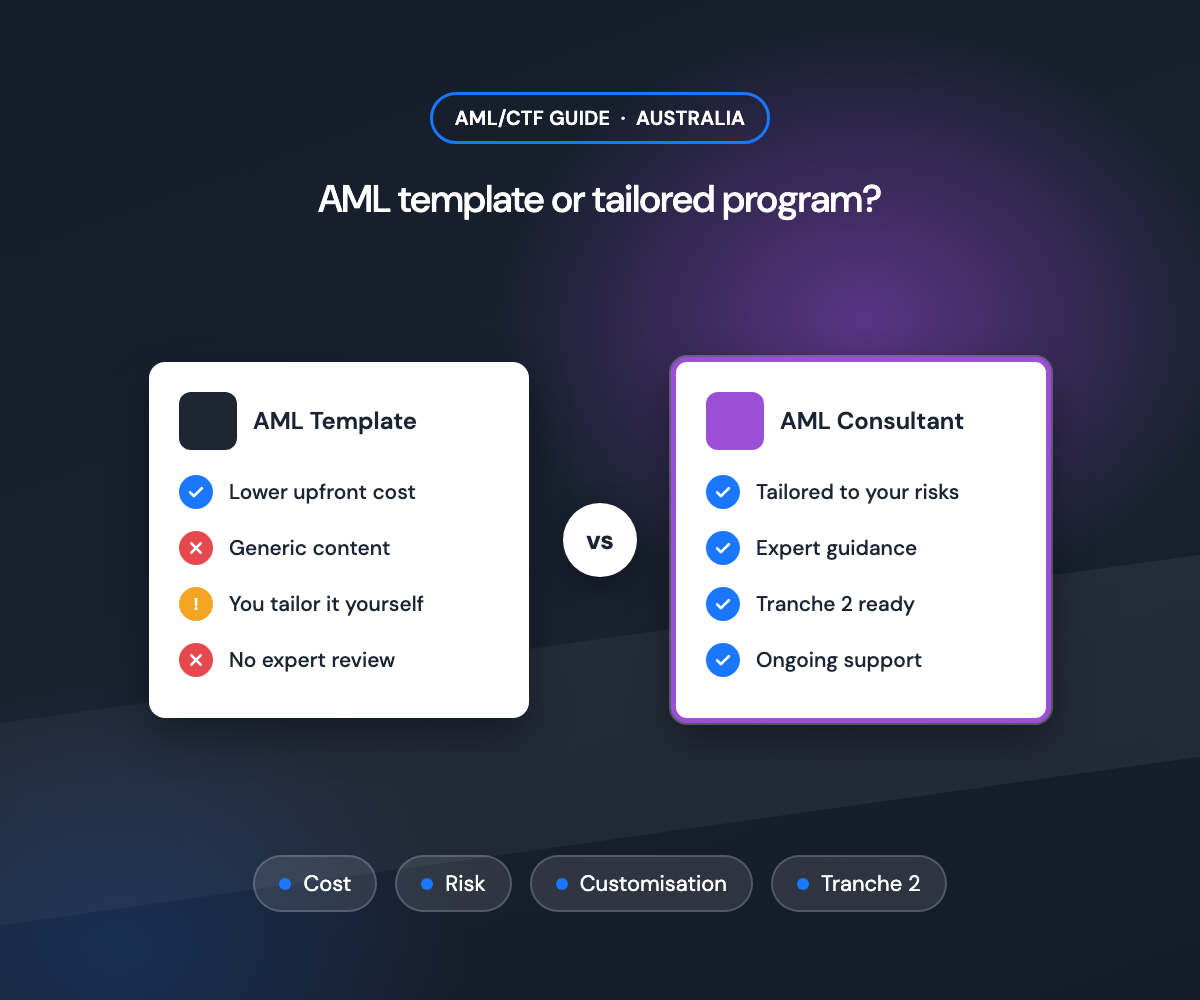
- Using generic templates without adapting them to the business
- Not understanding which services are captured by the AML/CTF regime
- Giving the AML/CTF compliance officer insufficient authority or resources
- Failing to provide appropriate staff training
- Not keeping the ML/TF risk assessment up to date
- Overlooking beneficial ownership risks
- Failing to apply appropriate customer due diligence
- Not documenting important compliance decisions
- Failing to review controls when services, customers or delivery channels change
These issues can be particularly relevant for businesses that have recently become subject to AML/CTF obligations.
What Should You Do If Your Business Is Not AML Compliant?
Discovering a compliance gap does not mean the business should ignore it or wait for AUSTRAC to raise the issue. A structured review can help identify what needs to be addressed and which issues should be prioritised.
1. Confirm Your AML/CTF Obligations
Start by confirming whether your business provides designated services captured by the AML/CTF regime and what obligations apply.
Your obligations depend on the services your business actually provides, not simply the industry or profession you operate in.
2. Identify the Gaps
Review your current AML/CTF framework and identify areas that are missing, outdated or not working as intended.
This may include your:
- AUSTRAC enrolment
- AML/CTF program
- ML/TF risk assessment
- AML/CTF compliance officer arrangements
- Customer due diligence processes
- Staff training
- Record keeping
- Reporting processes
3. Prioritise Higher-Risk Issues
Not every gap will carry the same level of risk.
Prioritise issues that could expose the business to significant ML/TF risk, such as inadequate customer identification, unclear beneficial ownership, unexplained sources of funds or ineffective controls for higher-risk customers.
4. Document Your Remediation Plan
Record what needs to be fixed, who is responsible, what action will be taken and when it should be completed.
Keeping evidence of the review and remediation process can also help demonstrate how the business is responding to identified weaknesses.
5. Get Professional Support Where Needed
If your business is unsure about its obligations or does not have the internal resources to address the gaps, professional AML/CTF support can help.
An external review can provide an independent perspective, identify weaknesses and help establish a practical remediation plan.
AML Compliance Checklist
Consider these questions as a starting point when reviewing your AML/CTF framework:
- Are you certain your business is required to enrol with AUSTRAC?
- Is your AML/CTF program current and tailored to your business?
- Is your ML/TF risk assessment up to date?
- Does your AML/CTF compliance officer have appropriate authority and resources?
- Do staff understand their AML/CTF responsibilities?
- Are customer due diligence processes applied consistently?
- Are beneficial ownership risks properly assessed?
- Are higher-risk customers appropriately identified and escalated?
- Are relevant sources of funds or sources of wealth checks being completed?
- Are suspicious matters reported when required?
- Are compliance decisions and supporting records properly documented?
- Are your AML/CTF controls reviewed when your business or risk profile changes?
If several answers are no, or you are unsure about some of them, it may be time to review your AML/CTF framework.
How One AML Can Help
One AML helps Australian businesses understand, implement and improve their AML/CTF obligations.
Support can include:
- AML/CTF program development
- ML/TF risk assessments
- AUSTRAC enrolment support
- AML/CTF compliance officer support
- Customer due diligence procedures
- Staff AML/CTF training
- AML/CTF health checks
- Independent reviews
- Compliance remediation
For law firms, accountants, real estate businesses, conveyancers and other reporting entities, One AML can help identify compliance gaps and develop practical processes your team can follow.
FAQs
What happens if you do not comply with AML laws?
If your business is required to comply with AML/CTF laws and does not meet its obligations, AUSTRAC may take compliance or enforcement action. Depending on the circumstances, this can include infringement notices, remedial directions, enforceable undertakings or civil penalty proceedings.
Can AUSTRAC issue penalties for AML/CTF non-compliance?
Yes. AUSTRAC can issue infringement notices for certain breaches and can apply to the Federal Court for civil penalty orders for relevant contraventions. The outcome depends on the specific breach and circumstances.
Is not having an AML/CTF program a serious issue?
If your business is required to have an AML/CTF program, failing to establish, document, approve or follow an appropriate program can create significant compliance risk. AUSTRAC specifically identifies AML/CTF program requirements among the obligations for which enforcement action may be taken.
What should I do if my business is not AML compliant?
Start by confirming which AML/CTF obligations apply to your business, identify any gaps, prioritise higher-risk issues and document how you will address them. Professional AML/CTF support can also help if the business does not have the internal expertise or resources to complete the review.
Can small businesses face AML/CTF compliance action?
Yes. If a small business is a reporting entity, it must meet the AML/CTF obligations that apply to it. However, its AML/CTF program and controls should be appropriate to the nature, size and complexity of the business.
Can One AML help fix AML/CTF compliance gaps?
Yes. One AML can help businesses review their AML/CTF frameworks, identify gaps, improve risk assessments and AML/CTF programs, support compliance officers, train staff and implement remediation plans.
Final Thoughts
AML/CTF non-compliance can affect much more than a business's relationship with AUSTRAC. It can create operational pressure, increase remediation costs, expose the business to financial penalties and make it harder to manage customer and financial crime risks effectively.
The best time to address a compliance gap is before it becomes a larger problem.
If you are unsure whether your AML/CTF framework is meeting your obligations, One AML can help you review your current approach, identify gaps and put practical controls in place.
An effective AML/CTF framework should be tailored to your business, kept up to date and embedded into everyday processes. It should help your team identify risks, conduct appropriate customer due diligence, escalate concerns and maintain the records needed to demonstrate compliance.
Contact One AML today to review your AML/CTF framework and take practical steps towards strengthening your compliance approach.
Ready to be free of your AML/CFT compliance stress?

