

AML Risk Assessment Mistakes to Avoid

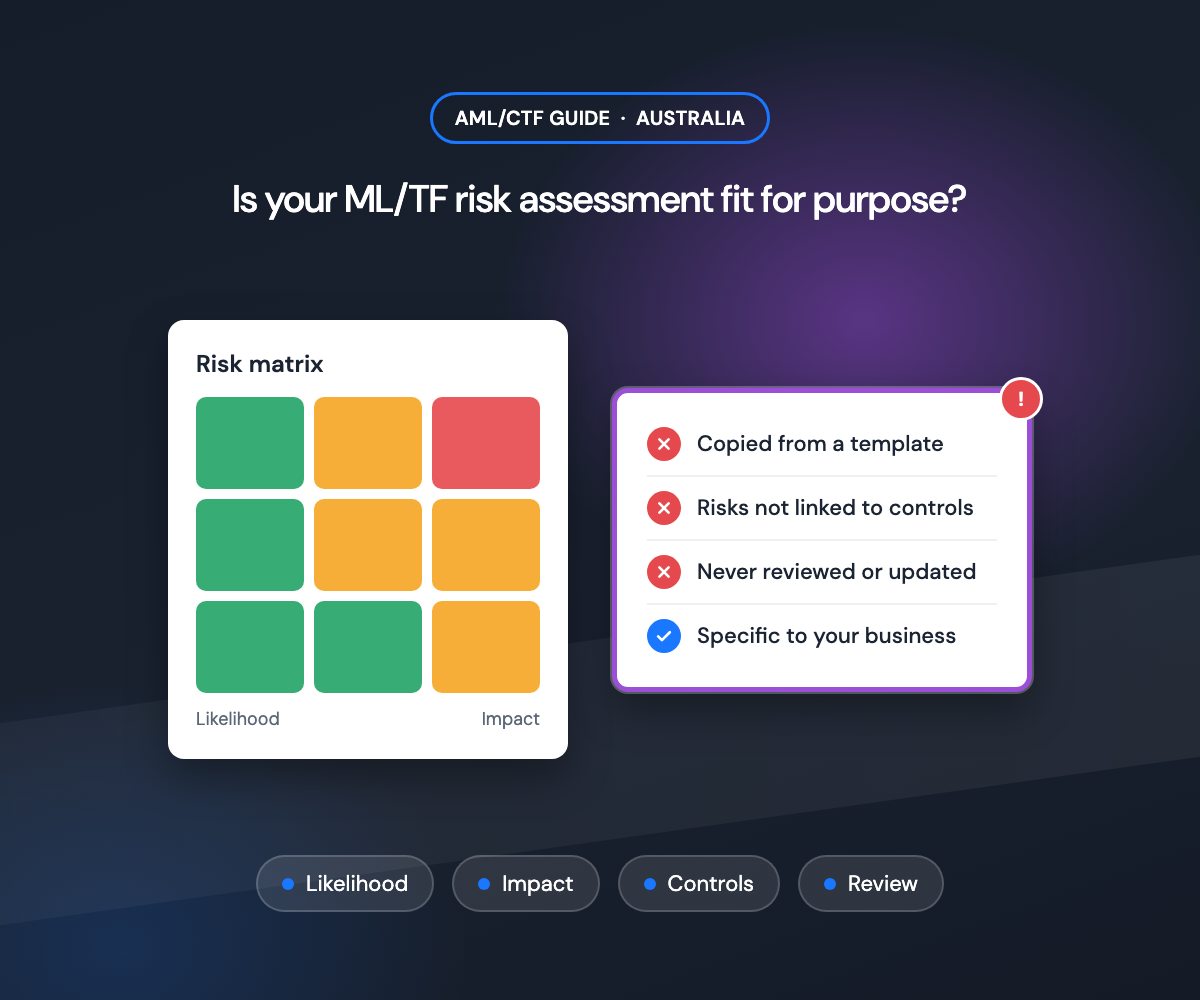
An AML risk assessment can look thorough, tick all the compliance boxes and still leave a business exposed.
The problem is often not whether an assessment exists, but whether it actually helps the business recognise and respond to risk. A generic template, unsupported risk ratings or an assessment that no longer reflects how the business operates can quickly become a document that sits on a shelf rather than a practical risk management tool.
For Australian businesses managing anti-money laundering and counter-terrorism financing (AML/CTF) obligations, including those affected by the Tranche 2 reforms, getting the risk assessment right is particularly important. An effective money laundering and terrorism financing (ML/TF) risk assessment should inform the AML/CTF program, customer due diligence, staff training, controls, escalation processes and ongoing monitoring.
So, what does a strong assessment need to cover, and which common mistakes could undermine it? Read on to explore the key AML risk assessment mistakes businesses should avoid and how to build a more practical approach to managing ML/TF risk.
Why AML Risk Assessment Mistakes Matter
An AML risk assessment should help a business understand where it may be exposed to money laundering and terrorism financing risks and what it needs to do about them.
The assessment should consider factors such as:
- Customers: Who the business deals with and whether certain customer types present higher risks.
- Services: The types of designated services provided and how they could be misused.
- Transactions: Transaction types, values, frequency and complexity.
- Delivery channels: How customers are identified and how services are delivered.
- Jurisdictions: Countries or regions connected to customers, transactions or business operations.
- Business structure: Ownership, control, related entities and third parties.
- Customer information: Beneficial ownership, source of funds and source of wealth where relevant.
- Governance and controls: Existing AML/CTF processes, systems, staff responsibilities and oversight.
A risk assessment that is generic, unexplained or out of date may not give the business a reliable basis for making AML/CTF decisions.
Mistake 1: Using a Generic Template Without Customising It
An AML risk assessment template can provide a useful starting point, but it should not be treated as a finished assessment.
The assessment needs to reflect the business's actual operations, services, customers and exposure to ML/TF risks.
For example, a business should consider:
- What services it provides
- Which services are designated services
- What types of customers it serves
- How customers are onboarded
- Whether services are delivered remotely or through intermediaries
- Which jurisdictions are involved
- Whether third parties are involved in transactions or payments
- What AML/CTF controls are already in place
Simply completing a template without explaining how the risks apply to the business can make the assessment difficult to rely on in practice.
Mistake 2: Rating Everything as Medium Risk
Another common mistake is assigning the same risk rating to almost everything.
If customers, services, delivery channels and jurisdictions are all rated as medium risk without a clear explanation, the assessment may not demonstrate that the business has properly considered its different risk exposures.
Risk ratings should be supported by a clear rationale. Depending on the business, this may involve categories such as low, moderate and high risk.
The assessment should also consider what controls are in place and whether any residual risk remains after those controls are applied.
The goal is not to give every risk a different rating. It is to show that the ratings reflect the actual risk and can guide appropriate action.
Mistake 3: Confusing the Business Risk Assessment With a Customer Risk Rating
A business-wide AML risk assessment and an individual customer risk rating serve different purposes.
The business risk assessment considers the overall ML/TF risks associated with the organisation, including its customers, services, delivery channels and jurisdictions.
A customer risk rating focuses on the risks associated with a particular customer or relationship.
For example, a business may generally have a moderate customer risk profile while identifying an individual customer as higher risk because of their ownership structure, source of funds, jurisdictional connections or other relevant factors.
Keeping these two assessments separate helps the business understand both its overall exposure and the risks associated with individual customers.
Mistake 4: Ignoring Actual Services and Designated Services
The services a business provides can significantly influence its ML/TF risk profile.
Businesses should assess how their specific services could be used to facilitate money laundering or terrorism financing rather than relying on broad industry assumptions.
For example, relevant considerations may include:
- Whether the business provides designated services
- Whether it handles high-value or complex transactions
- Whether client funds or third-party payments are involved
- Whether customers can use complicated ownership structures
- Whether certain services make it harder to understand the source or movement of funds
- Whether enhanced due diligence may be appropriate for certain situations
This is particularly important for businesses operating across professional services, accounting, legal, property and other sectors affected by AML/CTF obligations.
Mistake 5: Overlooking Delivery Channel Risk
The way a business delivers its services can create additional ML/TF risks.
For example, a business may have different risk considerations when onboarding customers:
- In person
- Online
- Through a third party or intermediary
- Using digital identification processes
- Without face-to-face contact
- Where supporting documents are provided remotely
Businesses should consider whether their delivery channels make customer identification, verification, beneficial ownership checks or ongoing monitoring more difficult.
A remote or digital process is not automatically high risk. The important question is whether the delivery method creates additional vulnerabilities and whether the business has appropriate controls to address them.
Mistake 6: Missing Beneficial Ownership Risk
Complex ownership structures can make it harder to identify who ultimately owns or controls a customer.
An effective risk assessment should consider whether the business may encounter:
- Companies with multiple layers of ownership
- Trust structures
- Offshore entities
- Nominee directors or shareholders
- Unclear or changing ownership
- Customers whose ownership or control is difficult to establish
These factors may increase the complexity of customer due diligence and should be reflected in the business's overall risk assessment and controls.
The assessment should also explain what the business will do when ownership or control cannot be readily established.
Mistake 7: Not Assessing Source of Funds and Source of Wealth Risk
For some businesses and customer relationships, understanding where money comes from can be an important part of managing ML/TF risk.
Relevant risk indicators may include:
- Funds coming from unrelated third parties
- Overseas sources of funds
- Transactions that do not appear consistent with the customer's circumstances
- Complex or unexplained transfers
- Unexplained wealth
- Inadequate or unsupported documentation
- Customers who are unwilling or unable to explain the source of funds
The assessment should identify when source of funds or source of wealth information may be relevant and what controls the business can use to address the associated risks.
Mistake 8: Failing to Connect Identified Risks to Controls
Identifying a risk is only part of the process. The assessment should also show how the business intends to manage it.
For example:
- Complex company ownership: Additional beneficial ownership checks and escalation
- Overseas source of funds: Appropriate source of funds verification
- Remote onboarding: Stronger identity verification controls
- Higher-risk customer: Enhanced due diligence and appropriate approval
- Third-party payments: Supporting documentation and AML/CTF review
This connection makes the risk assessment more practical because it shows what the business should do when a particular risk is identified. It can also help highlight gaps where the business has identified a risk but does not yet have an appropriate control in place.
Mistake 9: Leaving Senior Management Out of the Process
An AML risk assessment should not sit entirely with one compliance person or department.
Senior management or the governing body should have appropriate involvement in understanding the business's ML/TF risks and the controls used to manage them.
This may include considering:
- Changes to services or business strategy
- Higher-risk customer types
- Identified control weaknesses
- AML/CTF resources and systems
- Staff responsibilities and training
- Significant changes to the business's risk profile
Management involvement also helps ensure that identified risks and control gaps can be addressed rather than simply recorded in the assessment.
Mistake 10: Not Reviewing and Updating the Assessment
An AML risk assessment should not be treated as a document that is completed once and filed away. The assessment should be reviewed when there are material changes to the business or its risk profile. This may include:
- Introducing new services
- Entering new markets or jurisdictions
- Taking on new customer types
- Changing delivery channels
- Identifying new ML/TF risks or red flags
- Changes to the business's AML/CTF controls
- Findings from internal or independent reviews
- Relevant changes to AUSTRAC guidance or AML/CTF requirements
- Changes to technology or business processes
Regular review helps ensure the assessment continues to reflect how the business actually operates.
How to Avoid AML Risk Assessment Mistakes
A good AML risk assessment does more than identify risks. It gives the business a clear basis for deciding what controls, checks and actions are needed.
A practical approach includes:
- Map the services the business provides and identify relevant designated services.
- Identify the ML/TF risks associated with customers, services, transactions, delivery channels and jurisdictions.
- Consider beneficial ownership and source of funds or wealth risks where relevant.
- Assign clear risk ratings supported by documented reasoning.
- Connect identified risks to appropriate controls.
- Record control gaps and determine what action is required.
- Involve the AML/CTF compliance officer and appropriate senior management.
- Review and update the assessment when the business or its risk profile changes.
The goal is not to create the longest possible document. It is to create an assessment that helps staff and management make better AML/CTF decisions.
How One AML Can Help
Developing a practical AML risk assessment can be challenging, particularly for businesses preparing for or adjusting to Australia's expanded AML/CTF obligations.
One AML can help businesses with:
- ML/TF risk assessments
- AML/CTF program development
- Customer due diligence processes
- AML/CTF compliance officer support
- AUSTRAC enrolment
- Staff AML/CTF training
- AML/CTF health checks and remediation
The focus is on developing practical AML/CTF processes that reflect the business, its risks and its obligations.
FAQs
What are common AML risk assessment mistakes?
Common mistakes include using a generic template without customising it, assigning unsupported risk ratings, confusing business-wide risk with customer risk, overlooking beneficial ownership and delivery channel risks, failing to connect risks to controls, and not regularly reviewing the assessment.
Is an AML risk assessment the same as a customer risk rating?
No. An AML risk assessment considers the overall ML/TF risks faced by the business, while a customer risk rating considers the risk associated with a particular customer or business relationship.
Why is a generic AML risk assessment a problem?
A generic assessment may not accurately reflect the business's actual services, customers, delivery channels, jurisdictions or controls. This can make it difficult to use the assessment to make practical AML/CTF decisions.
How often should an AML risk assessment be updated?
The assessment should be reviewed when there are material changes to the business or its ML/TF risk profile. This can include new services, customer types, delivery channels, jurisdictions, identified risks, controls or relevant regulatory developments.
Who should be involved in an AML risk assessment?
The people involved will depend on the business, but the process should generally involve those responsible for AML/CTF compliance and appropriate senior management or the governing body.
Can One AML help fix AML risk assessment mistakes?
Yes. One AML can help businesses review and improve their ML/TF risk assessments, identify gaps, strengthen controls and align the assessment with the broader AML/CTF program.
Final Thoughts
An AML risk assessment should be more than a compliance document that gets completed and stored. It should give the business a practical understanding of its ML/TF risks, the controls used to manage those risks and the areas that need further action.
When the assessment is properly connected to the AML/CTF program, customer due diligence, staff training, governance and ongoing review, it becomes a useful tool for managing AML/CTF obligations rather than simply another compliance document.
If you need help reviewing your existing risk assessment or developing a practical ML/TF risk assessment for your business, One AML can help. Our team can assess your current approach, identify gaps and help you strengthen your wider AML/CTF framework. Contact us today.
Ready to be free of your AML/CFT compliance stress?

